
What’s typical, what to notice and when to get help, including pacifiers and tongue thrust
Written by Bodour Imseeh, BSc (Hons) Speech and Language Therapy (UEA), MSc Speech Difficulties (Sheffield), Speech and Language Therapist · Last reviewed: 22 October 2026
Have you noticed that your child still sucks their thumb or fingers, relies on a pacifier, breathes through their mouth or pushes their tongue forward when swallowing? These are common concerns for parents. Sometimes they’re part of typical development, and sometimes they’re linked to breathing difficulties, ongoing sucking habits or dental changes.
This guide explains what’s typical, which signs are worth noticing, and who to ask if you have concerns.
Please read this first. This page is for general awareness only. It isn’t an assessment, a diagnosis or therapy, and it doesn’t replace advice from a professional who has seen your child. Many of the signs below have medical causes, such as a blocked nose or large tonsils, so the right first step is often a doctor, not exercises.
Every child is different. This is a rough guide to the most useful ages to know, not a checklist. The ages follow US pediatric and pediatric dentistry guidance.
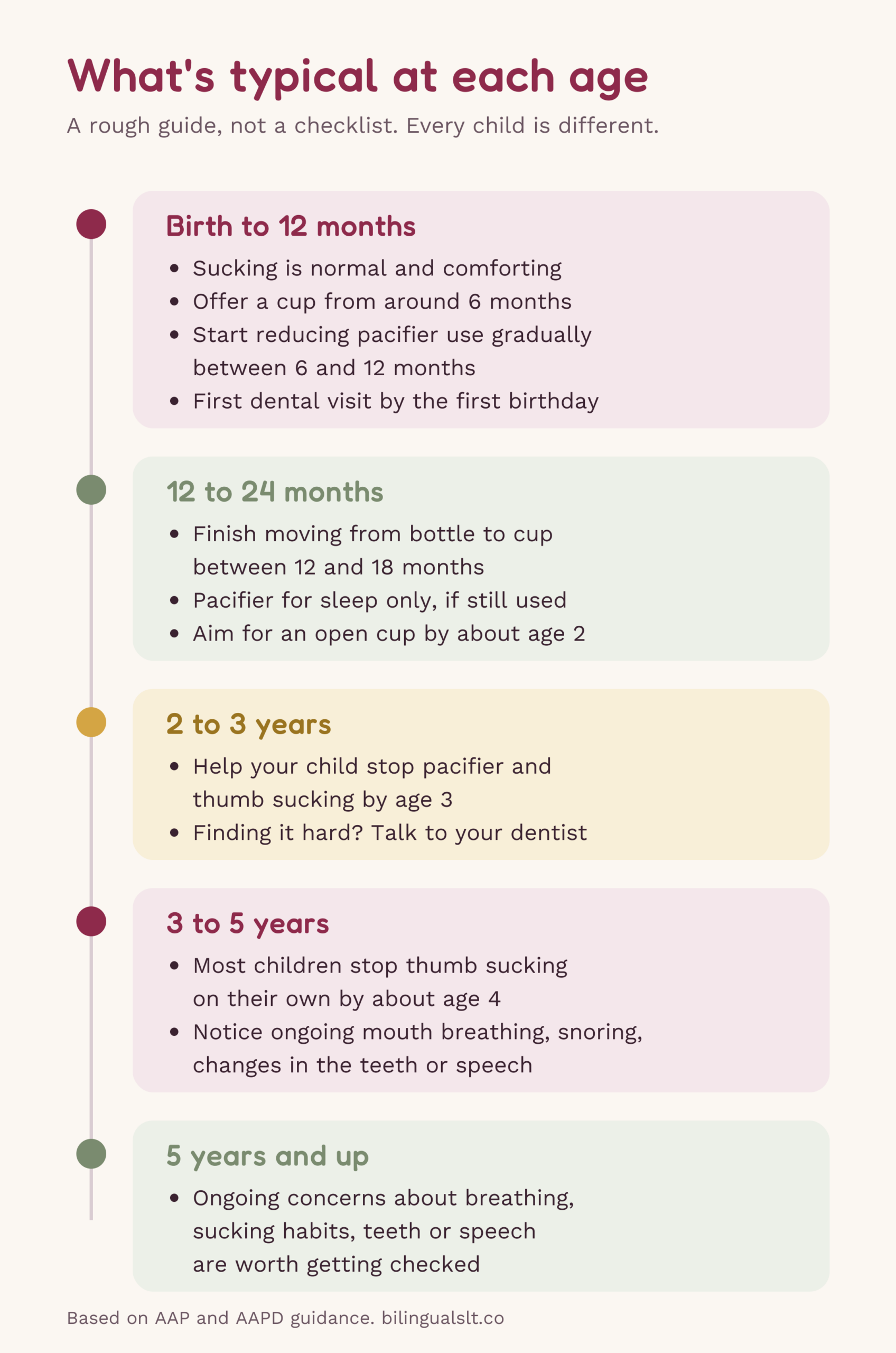
| Age | What families should know |
|---|---|
| Birth to 12 months | Sucking is normal and comforting. Offer a cup around 6 months, when solid foods start. US pediatric guidance suggests starting to reduce pacifier use gradually between 6 and 12 months, mainly to lower the risk of ear infections. Plan a first dental visit by the first birthday. |
| 12 to 24 months | Finish the move from bottle to cup between 12 and 18 months, and aim for an open cup by about age 2. If a pacifier is still used, keep it for sleep. After about 18 months, regular pacifier use can start to affect how the teeth develop. |
| 2 to 3 years | The American Academy of Pediatric Dentistry recommends helping children stop pacifier and thumb sucking by 36 months, to reduce the risk of dental changes. This is the latest point for the teeth, not a reason to keep a pacifier until then. If it’s hard to stop, talk to your dentist. |
| 3 to 5 years | Most children stop thumb sucking on their own by about 4. Notice persistent mouth breathing, snoring, changes in the teeth, or speech concerns. |
| 5 years and up | Ongoing concerns about breathing, sucking habits, teeth or speech are worth getting checked. |
Want to know more about how talking develops at each age? See our milestones tool.
Sucking is natural and comforting for babies and toddlers. Pacifiers, thumbs and bottles aren’t a problem in themselves. Habits become worth looking at when they carry on past the ages in the guide above, especially habits that continue for months or years.
Long-lasting sucking habits can affect how the teeth and jaw develop.
Worth noticing:
If you’re trying to reduce a habit, go gently. Shame and pressure tend to make habits stronger, not weaker.
A thumb can’t be put away, so the approach is different. Praise the times your child isn’t sucking, keep hands busy during triggers like TV time, and use gentle reminders, not punishment. If the habit continues past age 3, or you notice changes in the teeth or the roof of the mouth, ask your dentist or paediatrician. If the habit stops before the permanent front teeth come in, the bite often corrects itself, depending on the type and severity of the change.
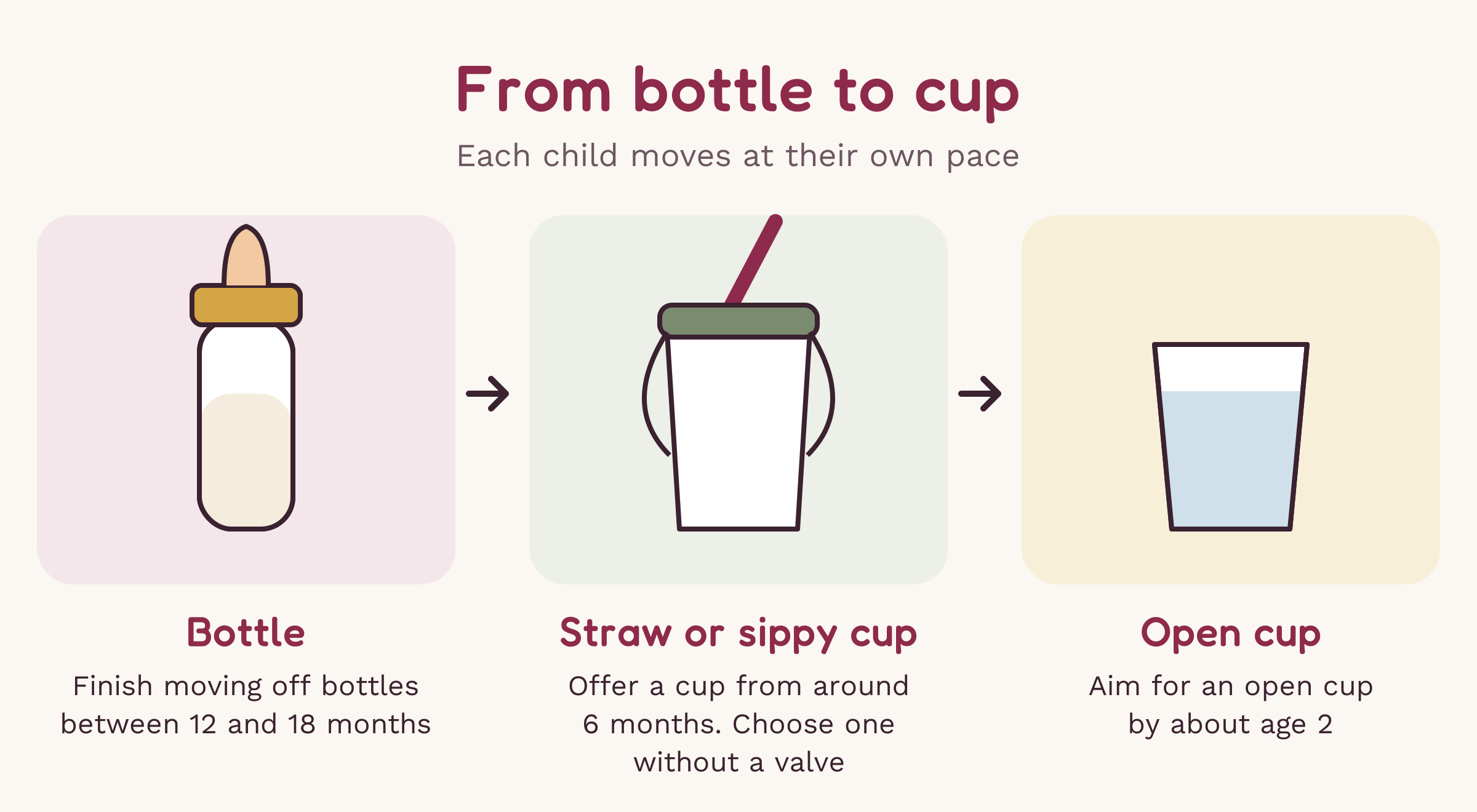
Offer a cup at meals, and keep any remaining bottles to mealtimes. Drop nap and bedtime bottles early, then the rest one at a time. Avoid letting your child walk around with a bottle or take one to bed. Sippy cups are optional. If you use one, choose a cup without a valve, since valved cups need sucking just like a bottle.
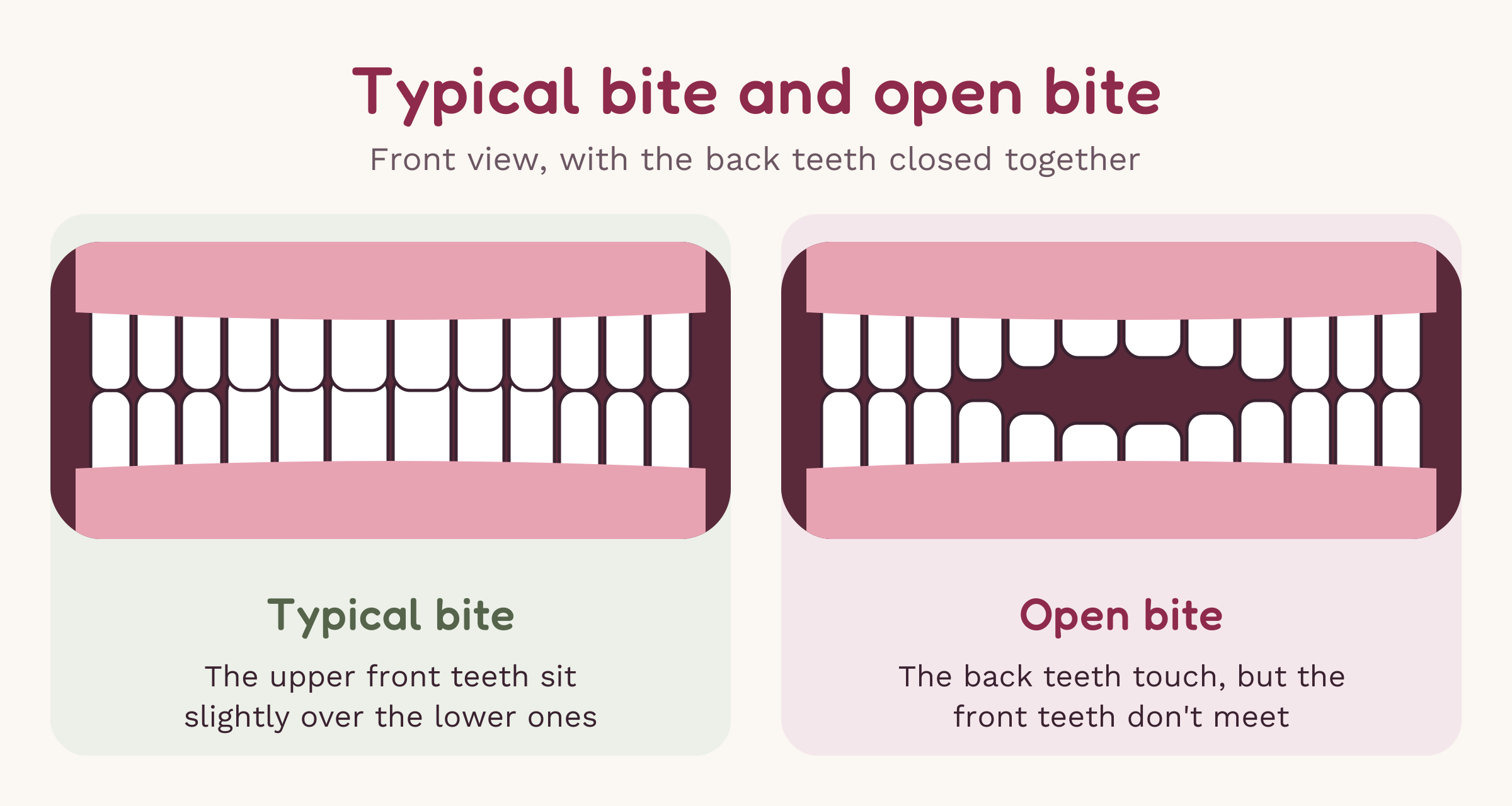
When relaxed, many children rest with their teeth slightly apart and the tongue up behind the top front teeth or near the bottom front teeth. Some variation is normal. You usually can’t see the tongue, and you don’t need to check where it is.
In young children, lips apart at rest can be normal too, because the lips are still growing. Many children don’t rest with their lips closed consistently until around the early teen years.
If your child’s mouth is usually open, the answer isn’t to train a new position. It’s to find out why, starting with whether they can breathe comfortably through their nose.
Signs worth noticing, if they happen most of the time over several weeks:
Every child has their mouth open sometimes, especially with a cold. Noticing one of these signs doesn’t mean something is wrong.
Get medical help promptly if your child often stops breathing, gasps or chokes during sleep. If your child is struggling to breathe at any time, seek emergency care.
Most of the time, children breathe through their nose, day and night. The nose warms, filters and moistens the air.
Talk to your child’s doctor if you notice:
Mouth breathing usually has a reason, such as allergies, a blocked nose, or enlarged tonsils or adenoids. A child can’t simply learn to breathe through a nose that isn’t clear, so the doctor comes first. Nose-blowing and treating colds promptly help day to day, but they won’t fix a nose that’s often blocked.

If your child regularly coughs, chokes or seems to struggle when eating or drinking, speak to their paediatrician. These signs need a feeding and swallowing assessment, not tongue posture exercises. If your child is choking but coughing hard, encourage them to keep coughing. If they can’t breathe, cough or speak, start choking first aid straight away and have someone call emergency services. First aid is different for babies under one, so a pediatric first aid course is worth taking.
Swallowing patterns change as children develop feeding skills. Swallowing patterns vary, and the tongue coming forward now and then isn’t a problem on its own.
Some children keep a strong tongue-forward swallow as they get older. You may hear this called a “tongue thrust.” It can be worth an assessment, especially alongside changes in the teeth, but it isn’t something to diagnose at home. A dentist, orthodontist or speech-language pathologist (speech and language therapist) can check it.
Signs worth mentioning to a professional:
Messy eating or difficulty with new textures is a separate question with many possible causes. The table below shows who to ask.
There’s no evidence that speaking two languages causes differences in mouth posture, breathing or swallowing. There’s no need to drop a language because of these concerns.
Seeing the tongue during speech is different from seeing it at rest. A child’s tongue may be visible when producing certain speech sounds, and that can be completely appropriate. What matters is which sound they’re making, how it sounds, and whether it’s expected in their language or dialect.
Some Arabic sounds are made with the tongue between the teeth. ث، ذ and ظ (as in ثعلب، ذهب، ظرف) are conventionally produced this way (an interdental articulation), though everyday dialectal speech often differs. In many spoken dialects, for example, ث may be said as ت or س.
For س، ز and ص in Arabic, and “s” and “z” in English, the tongue usually stays behind the teeth. If your child often pushes the tongue forward on these sounds after about age 4½, it may be worth asking a speech-language pathologist. They’ll consider how the sound actually sounds and which dialect your child speaks.
If you see a professional, tell them which languages and which dialect your child speaks. That way they can judge your child’s sounds against the right standard.
If you’ve noticed several of the signs above, or one sign that’s persistent, it’s worth asking a professional. Start with the person who fits your main concern.
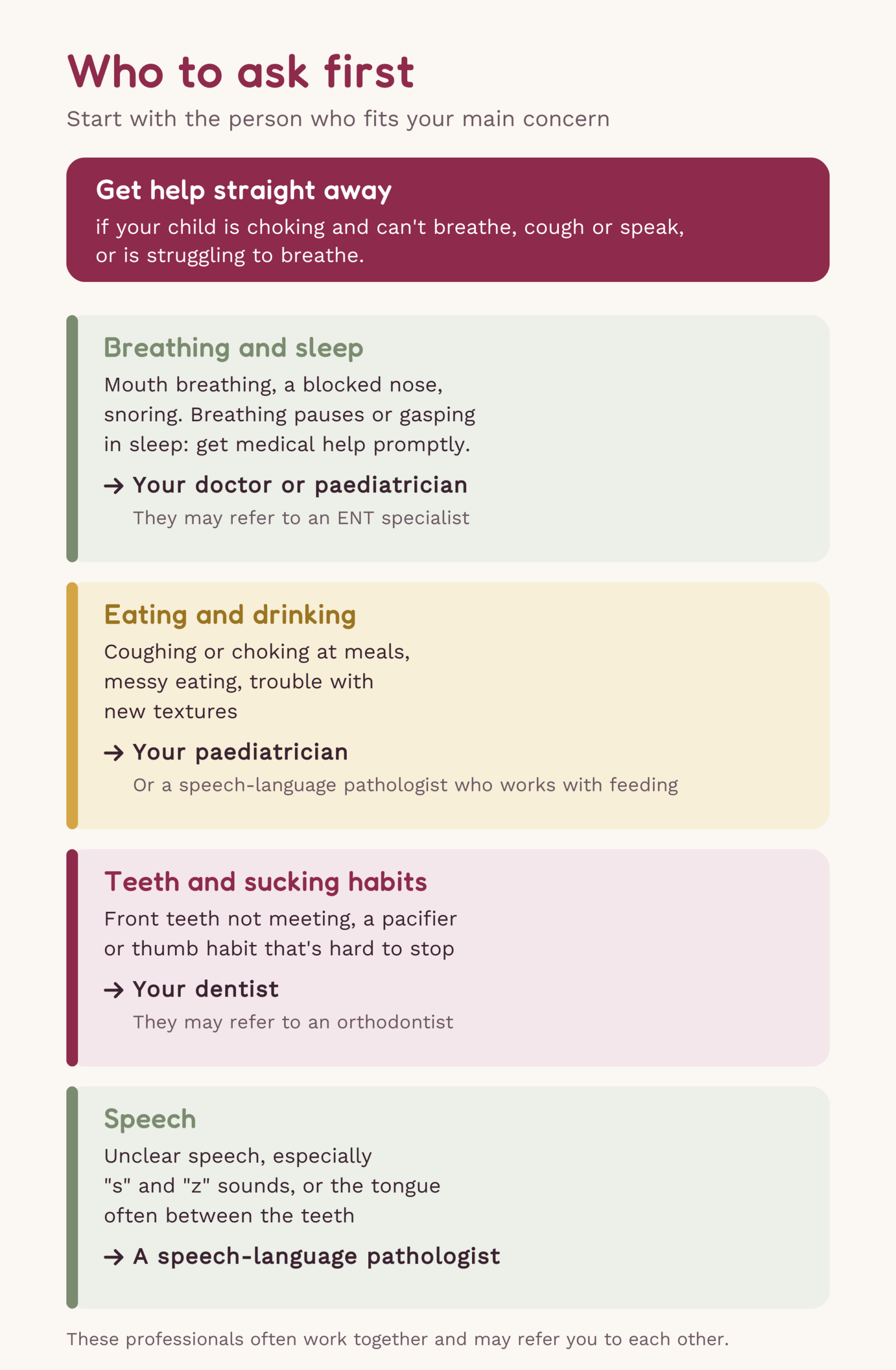
| What you’ve noticed | Who to start with |
|---|---|
| Regular snoring or restless sleep (for breathing pauses or gasping, get medical help promptly) | Your child’s doctor or paediatrician. They may refer to an ENT (ear, nose and throat) specialist. |
| Coughing, choking or struggling when eating or drinking | Your paediatrician, who may refer you for a feeding and swallowing assessment |
| Mouth breathing or a blocked nose most of the time | Your child’s doctor or paediatrician, and possibly an allergy check |
| Teeth not meeting at the front, or concerns about how teeth are growing | A dentist, who may refer to an orthodontist |
| Tongue between the teeth at rest or when swallowing | A dentist or orthodontist, or a speech-language pathologist |
| Messy eating or drinking for their age, food often pushed out of the mouth, or difficulty moving on to new textures | Your paediatrician, or a speech-language pathologist who works with feeding |
| Unclear speech, especially “s” and “z” sounds | A speech-language pathologist |
| A sucking habit you’re struggling to reduce | Your child’s doctor or dentist for guidance |
These professionals often work together. One may refer you to another, and that’s a normal part of the process.
A little preparation helps the professional see what you see at home.
Research linking pacifiers to speech delay is limited. Some research suggests very long daily use, several hours a day, may be linked to some speech errors, but the evidence is weak. Pacifier use at sleep time is a smaller concern.
Reminders often don’t change a habit, and some children can’t breathe comfortably through their nose. Finding the reason comes first.
Many children do, especially when habits stop early. If a sucking habit continues past age 3, or other signs on this page carry on, get them checked.
Some are marketed as gentler on the teeth, but US pediatric dentists say the evidence isn’t strong enough to recommend them over regular pacifiers. Stopping the habit matters more than switching to a different shape.
Sometimes a tight tongue-tie can limit how the tongue moves, for example making feeding harder. Evidence that tongue-tie affects speech is limited. Many children with a tongue-tie have no problems at all. Only a professional who examines your child can tell you whether it’s relevant. How a tongue-tie looks on its own isn’t a reason for treatment.
It can be part of the picture. Saying “s” with the tongue between the teeth is common in young children, often until around 4½, though children vary. After that, a speech-language pathologist can check what’s going on. If the “s” sounds slushy or wet, with air escaping at the sides of the tongue, that isn’t generally part of typical speech development, so it’s worth getting checked sooner.
We don’t recommend starting exercises without an assessment. The cause matters, and exercises won’t help if, for example, the nose is blocked. A professional can tell you whether therapy is needed and what kind.
You know your child best. Noticing one of these signs doesn’t automatically mean something is wrong. If something about how your child breathes, rests their mouth or swallows is on your mind, it’s always fine to ask.
Looking for simple ways to support your child’s talking during everyday routines? Try our Try Something Today tool.