What counts as a word, why both languages belong in the count, and when a small vocabulary is worth a conversation.
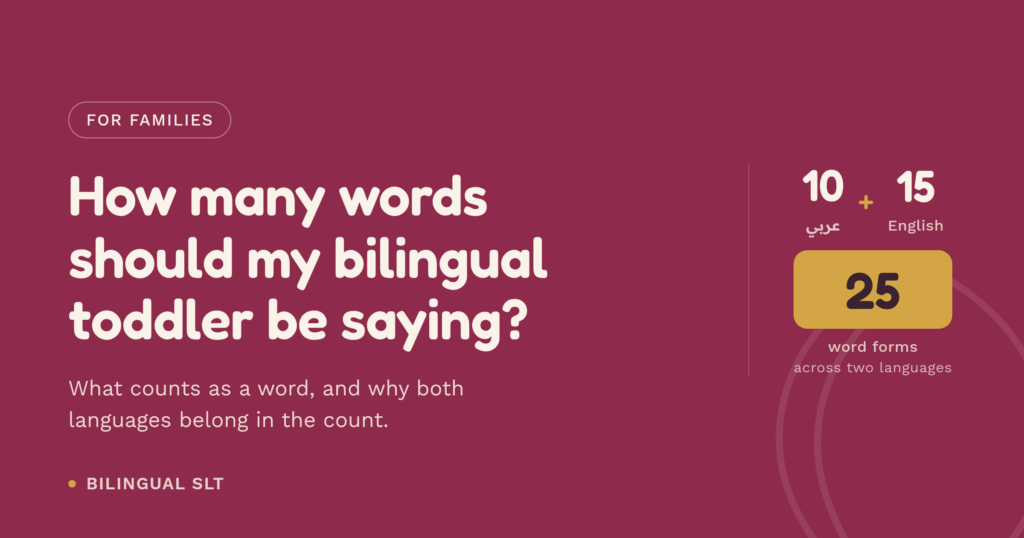
My child says 10 words in Arabic and 15 in English. Does that mean they know 25 words?
It depends what you are counting, and counting one language on its own will almost always underestimate a bilingual child.
Quick answer: count words from both languages, not just one. If your child says 10 words in Arabic and 15 in English, that is 25 word forms across their two languages. How many words to expect depends on their age, and vocabulary is only one part of language development. Understanding, gestures, word combinations and how your child gets their message across all matter too.
How many words should a bilingual toddler say at each age?
There is no separate milestone chart for bilingual children. Below is the CDC’s checklist, which lists what most children (75% or more) can do by each age.[1] That percentage matters: these are minimum expectations, not averages. A child who has not reached one is in roughly the bottom quarter, which is a reason to ask, not to panic.
| Age | What most children can do | What this tells you about words |
|---|---|---|
| 12 months | Waves bye-bye. Calls a parent “mama” or “dada” or another special name. Understands “no” | No vocabulary count at this age |
| 15 months | Tries to say one or two words besides “mama” or “dada”, like “ba” for ball | First words. Approximations count |
| 18 months | Tries to say three or more words besides “mama” or “dada”. Follows a one-step direction without gestures | Still no vocabulary size given |
| 24 months | Says at least two words together, like “More milk”. Points to things in a book when you ask | Putting words together matters more here than the total |
| 30 months | Says about 50 words. Says two or more words together with an action word, like “Doggie run” | The first age with a word count attached |
You may have seen “50 words by two” somewhere. That number is real, but it comes from elsewhere: it is a screening cut-off for identifying late talkers, developed with monolingual English-speaking children.[2] It wasn’t designed for a child whose words are split across two languages, so add up the words in both languages first. Counted that way, fewer than about 50 words at 2 years is still a reason to ask for advice, though not a diagnosis.
For what most children do at these ages beyond words, including understanding, play and eating, see the milestones for 13 to 18 months and 19 to 24 months.
Do words in both languages count?
Yes.
If your child says 10 different words in Arabic and 15 in English, that is 25 word forms. Some may be translation equivalents, like ball and كرة, where your child has two words for one idea.
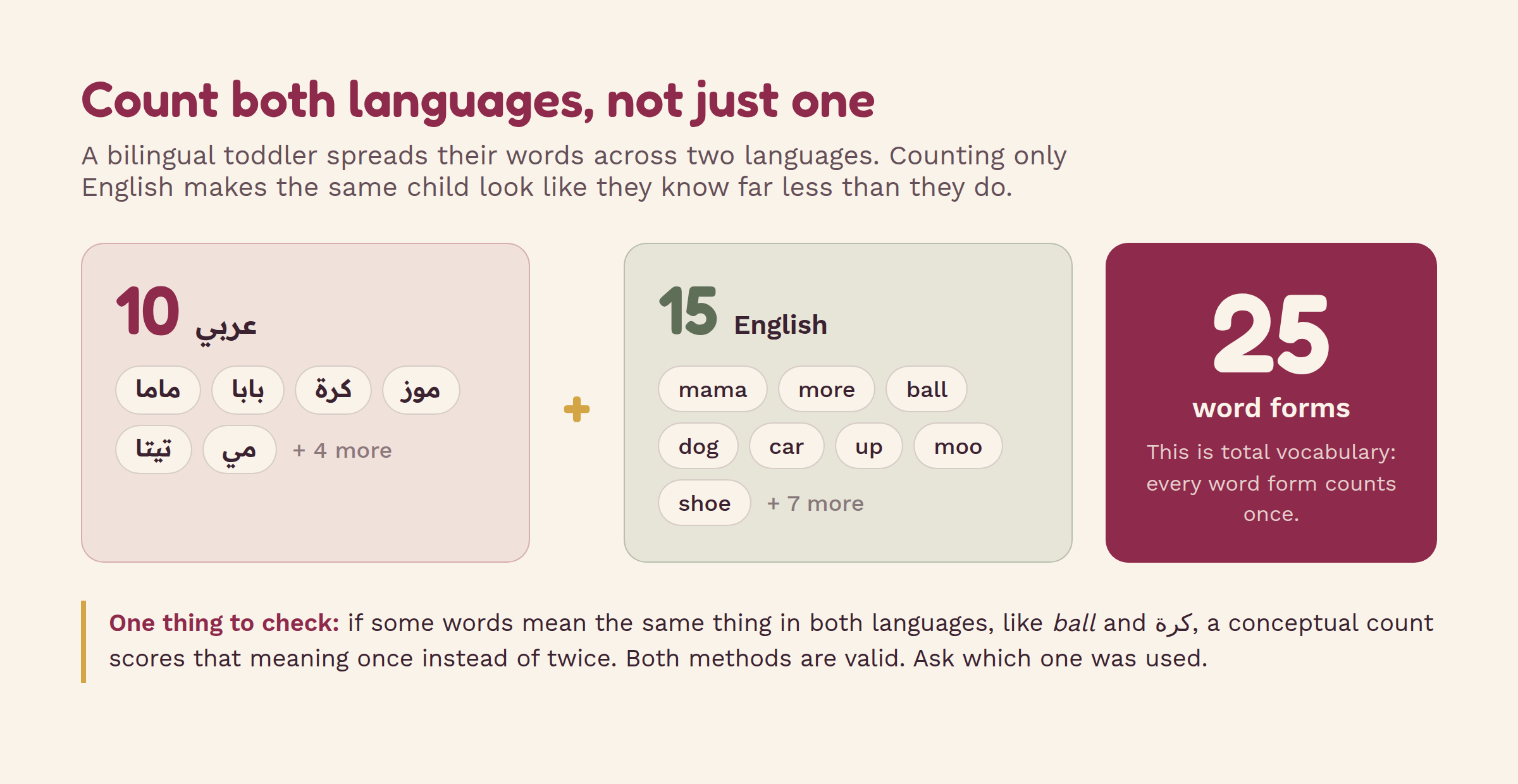
Both ways of counting have names. Total vocabulary counts every word form, so ball and كرة are two. Conceptual vocabulary counts the meaning once, so they are one. Both are legitimate; a therapist should tell you which they used.
This is not a technicality. When combined vocabularies are measured, bilingual children acquire vocabulary at about the same rate as monolingual children.[3] Measure only English and the same child can look delayed when they are not.
What actually counts as a word?
More than parents expect. A word counts when your child uses it on their own, consistently, to mean something:
- A clear word: mama, ماما, more
- A consistent approximation: ba for ball, du for shoe
- A meaningful sound effect: moo for a cow
- A word in either language, including words only your family uses
Two things that do not count: words your child only repeats after you, and words produced once and never again. Gestures are not words either, but they are good news, and a therapist will note them separately.
One caution: the standard English checklists ask parents to tick English words only. If you fill one in, say your child is bilingual and ask whether the other language is being counted.
Does being bilingual mean my child will talk later?
No. Learning more than one language does not cause speech or language problems.[3]
What two languages change is how words are spread out. Children learn words where they meet them, so nursery words often arrive in English and food, family and religious words in Arabic. That is distribution, not delay.
There is more on this in “Is speaking two languages causing my child’s speech delay?“
When should I be concerned about my bilingual toddler’s speech?
Worth raising with your health visitor, GP or a speech and language therapist:
- Very few words across both languages together, or a vocabulary not growing month to month
- Not understanding familiar instructions in the language they hear most
- Not using gestures, pointing or other ways of getting your attention
- Losing words or skills they had before
- Your own sense that something is not right
You do not have to wait until your child is older, or until they are fluent in one language first. Being bilingual is not a reason to delay asking, and no one should tell you to drop a language as the answer.[2]
Equally, one quiet month is not a crisis. What matters is the pattern over time, across both languages.
How can I encourage my bilingual toddler to use more words?
Three things, all free, none requiring worksheets:
- Follow what they are interested in. Talk about what they are looking at, not what you had planned.
- Say it back, slightly bigger. They say “car”, you say “big red car”. No need to make them repeat it.
- Keep using the language you are most comfortable in. Natural conversation in Arabic does more than careful, effortful English.
For small everyday ideas you can try the same day, see “Try Something Today“.
Frequently asked questions
Does saying the same word in Arabic and English count as two words?
It depends which count is being used. In total vocabulary, ball and كرة are two word forms. In conceptual vocabulary, they are one concept your child can express in two languages. Neither is wrong. What matters is that whoever is counting tells you which method they used, and that both languages are included.
Should I count words my toddler understands but doesn’t say?
Count them separately, and do mention them. Understanding usually runs ahead of talking, and a child who understands a lot but says little is in a very different position from one who understands little. Milestone checklists refer to the words your child says.
Should I be worried if my toddler speaks more English than Arabic?
Not on its own. Uneven languages are normal and the balance shifts with how much your child hears and uses each one, especially once nursery starts. Look at both languages together rather than at Arabic alone. If the total is small or not growing, that is worth asking about.
Where to go next
- My bilingual child isn’t talking yet. When should I worry? — The signs by age that mean it’s worth asking for advice, counting words in both languages.
- Does My Child Need Speech Therapy? — What to notice, when to ask, and what happens next.
Sources and further reading
- Centers for Disease Control and Prevention. Learn the Signs. Act Early. milestone checklists, revised 2022. https://www.cdc.gov/act-early/milestones/index.html
- American Speech-Language-Hearing Association. Late Language Emergence (Practice Portal). The source of the “fewer than 50 words by 24 months” screening criterion, and of the guidance that monolingualism should not be advised in response to a language delay. https://www.asha.org/practice-portal/clinical-topics/late-language-emergence/
- American Speech-Language-Hearing Association. Communication Milestones. Includes guidance for multilingual families. https://www.asha.org/public/developmental-milestones/communication-milestones/