By Bodour Imseeh, Speech and Language Therapist. Published 31 October 2026. Last clinically reviewed 17 October 2026.
A three year old names 40 pictures in English and scores at the fifth percentile. She also knows 25 words in Arabic that the English test never asked about, and roughly a third of those overlap with words she produced in English. Which number goes in the report, and what does it license you to say? Total and conceptual vocabulary are the two standard answers, they give different results, and the choice between them changes who gets flagged. This article sets out how each is calculated, what the evidence says about their behaviour, and where both stop being useful.
The short answer: total vocabulary sums every word a child produces across their languages, counting translation equivalents twice. Conceptual vocabulary counts each concept once regardless of how many languages it appears in. Neither is simply more accurate. Total vocabulary tracks monolingual growth more closely in toddlers, conceptual vocabulary penalises balanced bilinguals, and no vocabulary score on its own establishes or rules out a language disorder.
Key points
- The two measures differ by exactly the number of translation equivalents.
- Summing across languages does not make monolingual norms valid.
- Conceptual scoring reduces one bias but introduces another.
- No vocabulary scoring method has reached 80% sensitivity and specificity.
- For Arabic, which variety the items are written in is a measurement variable.
What total vocabulary is
Total vocabulary is the sum of the words a child knows across two languages [1]. A child with 40 English words and 25 Arabic words has a total vocabulary of 65, whether or not some of those words name the same thing.
What conceptual vocabulary is
Conceptual vocabulary gives the child credit for knowing concepts rather than words, and concepts represented in both languages are counted only once [1]. In practice the conceptual score is the total minus the number of concepts occurring in both languages. Where a concept has more than one corresponding word, credit is given if the child produces either.
The name is slightly misleading, and worth flagging to anyone using it. Conceptual vocabulary is an operational scoring rule applied to lexical items, not a direct measure of conceptual knowledge, and translation equivalence is rarely the clean one-to-one match the arithmetic assumes.
A worked example
| English | Jordanian Arabic | Concept |
|---|---|---|
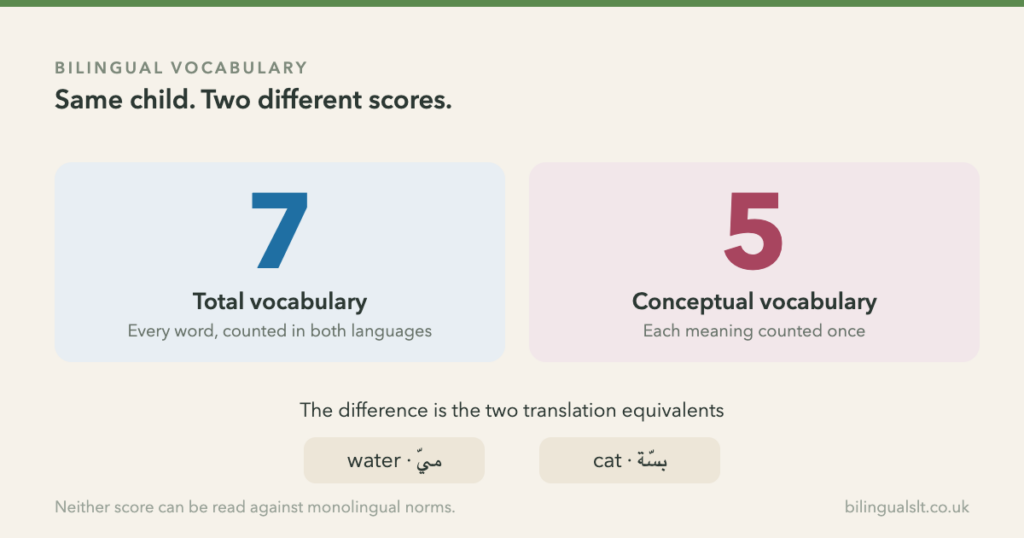
| water | ميّ | Water |
| cat | بسّة | Cat |
| ball | not produced | Ball |
| not produced | بابا | Dad |
| dog | not produced | Dog |
Four English words plus three Arabic words gives a total vocabulary of 7. Five distinct concepts gives a conceptual vocabulary of 5. The difference is exactly the two translation equivalents, water and cat, counted twice in one measure and once in the other.
Illustrative data, not a standardised result, and it assumes the listed pairs are genuine equivalents for the intended meanings.
What the research says
Does total vocabulary track bilingual development better?
In 47 Spanish-English bilingual children and 56 monolingual controls tested at 22, 25 and 30 months, total vocabulary produced mean scores and growth rates similar to monolingual growth, while conceptual vocabulary fell significantly below the monolingual comparison by 30 months [1]. The clinically important result is at the cut-point rather than the mean. Using total vocabulary, the proportion of bilingual children falling at or below the 25th percentile did not differ from monolinguals at any age. Using conceptual vocabulary, significantly more bilingual children fell below that cut-point at 22 months and again at 30 months. The authors recommend a total vocabulary score for young Spanish-English bilinguals, and note it has the practical advantage of not requiring any estimate of relative language exposure.
That is one language pair, one parent-report instrument, productive language only, and a relatively high socioeconomic sample. The authors say so.
How do these scores behave against monolingual norms?
Not interchangeably, which is the point. In 115 Spanish-English children in kindergarten and first grade, single-language scores related linearly to relative language skill, under-crediting children stronger in the other language in both directions. Conceptual scores showed a quadratic relationship, meaning children with the most balanced skills in both languages received the lowest conceptual scores. Total scores showed no association with relative language skill at all [2].
Three scoring methods, three different measurement behaviours. None of them is the quantity a monolingual norm table was built from. ASHA’s position on normative samples is unambiguous: standard scores should not be determined where the norming sample does not adequately represent the individual being assessed [3]. The RCSLT-commissioned UK guidance is blunter still, stating that scores developed on a monolingual population should never be used to diagnose a speech, language and communication disorder in a bilingual child, since by definition bilingual speakers are not monolingual speakers of either of their languages [4].
Summing across languages addresses one specific unfairness, which is failing to credit knowledge held in the other language. It does not convert the result into a normed score.
Can vocabulary counts separate difference from disorder?
On current evidence, no, and this is the section most worth reading twice.
In 247 Spanish-English bilingual children aged 5;1 to 11;1, six scoring methods were compared: two single-language and four conceptual. Across-test conceptual scoring, which combines separate administrations in each language, performed best and beat within-test scoring, which credits an other-language response during one administration. Both beat single-language scoring. But no method reached the minimum standard of 80% sensitivity and specificity [5].
Conceptual scoring also helps unevenly. In 98 children aged 5 to 7, conceptual scoring eliminated the receptive vocabulary gap between monolinguals and simultaneous bilinguals, but the expressive gap remained, and for sequential bilinguals differences remained in both modalities [6]. The authors suggest it is most useful for ruling a vocabulary deficit out rather than ruling one in.
The sharpest figure comes from Montreal. A receptive vocabulary test applied to bilingual five year olds achieved 100% sensitivity but 43% specificity, meaning it wrongly flagged more than half the typically developing bilingual children. In the same study, receptive vocabulary failed to separate monolingual children with language impairment from typically developing bilingual children at all. Nonword repetition reached 79% specificity in the bilingual group, and vocabulary correlated far more strongly with exposure than nonword repetition did [7]. Sentence repetition with bilingual cut-offs performs better again [8].
Vocabulary tells you about exposure as much as ability, which makes it informative and non-diagnostic at the same time.
Translation equivalents and their limits
Reported proportions of translation equivalents in young bilingual lexicons range from 0% to 84% [1], so there is no typical figure to work from. In one foundational study of 27 children aged 0;8 to 2;6, translation equivalents appeared in all but one child and averaged around 30% of words, at both very small and much larger vocabulary sizes [9].
That paper is routinely cited as evidence that bilingual toddlers have a single integrated lexicon. It is not. What it ruled out was the claim that bilingual toddlers avoid cross-language synonyms, and the authors explicitly decline to settle the one-versus-two-lexicons question. If you see it cited the other way, the citation is wrong.
A further practical caution: the overlap between the item sets of two parent-report inventories is itself a property of the instruments, not of the child. The English CDI and its Spanish counterpart overlap on roughly 70% of items [1], which constrains how many translation equivalents the scoring can detect in the first place.
Choosing a measure
| Clinical question | What this points to |
|---|---|
| How many lexical forms does this child produce across languages? | Total vocabulary |
| How many distinct meanings are represented? | Conceptual vocabulary, read with its limits in mind |
| Is the child balanced across their languages? | Conceptual scoring may under-credit them [2] |
| Is this child’s English behind monolingual peers? | A single-language English score answers that, and only that |
| Is a language disorder suspected? | Vocabulary contributes; repetition tasks discriminate better [7, 8] |
| Are the translation pairs dialectally variable? | Review item-level scoring before totalling anything |
Terminology is inconsistent across studies and tools, including variants such as total composite vocabulary. Before comparing one study’s figure with another’s, check how each defined and calculated the score.
Arabic-English considerations
Two things make Arabic vocabulary assessment harder than the Spanish-English literature implies.
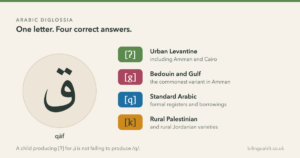
The first is dialect. If an assessment treats قطة as the expected Arabic translation of cat but the child says بسّة, that is a lexical difference, not an absence of vocabulary knowledge. Scoring it as an error converts a dialect fact into a clinical finding. The same applies wherever a tool uses Standard Arabic forms: in a corpus of 4,408 word types from the spoken lexicon of five year old Palestinian Arabic speakers, only 21.2% were identical in form to the Standard Arabic equivalent, with 40.6% cognates differing in phonological form and 38.2% entirely different words [10]. Arabic diglossia and its impact on speech and language assessment covers that distance in more detail.
That distance has measurable consequences. In 100 children learning novel words, items containing a Standard Arabic consonant absent from the children’s dialect were learned less well by everyone, and in production the penalty was larger for children with DLD [11]. The variety an Arabic vocabulary item is written in is a measurement variable, not a formatting detail.
The second is norms. An early adaptation of the CDI across 17 Arabic varieties found that Egyptian norms could be reasonably extrapolated to a pooled sample from 16 other countries, while restricting clinical use to children learning Egyptian Arabic and flagging small per-dialect samples [12]. A later standardisation with much larger stratified samples did not reproduce that: norms were computed separately by country, a single set held only for Jordan and Palestine at 8 to 30 months, and three separate sets were needed at 30 to 48 months, which the authors describe as showing the limits of a pan-Arabic word list [13]. Read an Arabic CDI score against norms for the child’s own variety where they exist, and treat cross-dialect application as an open question rather than a solved one.
For Arabic-English bilinguals specifically, UK clinicians are extrapolating. There is no Arabic-English conceptual scoring study, no Arabic-English bilingual vocabulary norms, and no diagnostic accuracy data for this pair. The nearest evidence is Arabic-German, where a standardised Levantine Arabic battery flagged 12 of 18 typically developing heritage bilingual children as meeting criteria for DLD, largely on vocabulary and morphosyntax production, while a sentence repetition task did not [14]. For the speech side of the same picture, see Cross-linguistic influence in Arabic-English bilingual speech.
Common mistakes
Reporting a single-language score as though it describes the child’s language. It describes their language in the language tested. Treating a summed score as comparable to a monolingual norm. It is not [3, 4]. Counting a dialect-appropriate word as an error. Assuming translation equivalence is one-to-one. And reaching a diagnostic conclusion from vocabulary alone, which no scoring method currently supports [5, 7].
Frequently asked questions
What is the difference between total and conceptual vocabulary? Total vocabulary sums words across languages and counts translation equivalents twice. Conceptual vocabulary counts each concept once. The two scores differ by exactly the number of translation equivalents.
Should translation equivalents be counted once or twice? It depends on the question. Count twice for total vocabulary, once for conceptual vocabulary. Be explicit about which you used, because the scores are not comparable.
Is total or conceptual vocabulary more accurate? Neither, in general. Total vocabulary tracked monolingual growth more closely in Spanish-English toddlers and flagged fewer children at the 25th percentile [1], but conceptual scoring systematically under-credits balanced bilinguals [2].
Can bilingual vocabulary scores be compared with monolingual norms? Not for diagnosis. Standard scores should not be determined where the norming sample does not represent the child [3], and summing across languages does not change that [4].
Can low vocabulary in one language indicate DLD? Not on its own. A receptive vocabulary test applied to bilingual five year olds showed 43% specificity, wrongly flagging more than half the typically developing children [7].
Key takeaways
Decide which measure answers your question before you score, state in the report which one you used and in which languages and varieties, and do not let either number carry a diagnosis by itself. Total vocabulary behaves better against monolingual growth curves in toddlers; conceptual vocabulary penalises the most balanced bilinguals; and no method yet reaches acceptable classification accuracy. For Arabic-English children there are no norms for this language pair at all, so the honest report says what was assessed, in which variety, and what remains uncertain.
References
- Core, C., Hoff, E., Rumiche, R., & Señor, M. (2013). Total and conceptual vocabulary in Spanish-English bilinguals from 22 to 30 months: implications for assessment. Journal of Speech, Language, and Hearing Research, 56(5), 1637-1649. https://doi.org/10.1044/1092-4388(2013/11-0044)
- Fitton, L., Goodrich, J. M., Thayer, L., Pratt, A., & Luna, R. (2023). Bilingual vocabulary assessment: examining single-language, conceptual, and total scoring approaches. Journal of Speech, Language, and Hearing Research, 66(9), 3486-3499. https://doi.org/10.1044/2023_JSLHR-22-00573
- American Speech-Language-Hearing Association. Assessment tools, techniques, and data sources. ASHA Practice Portal. https://www.asha.org/practice-portal/resources/assessment-tools-techniques-and-data-sources/
- Stow, C., & Pert, S. SLT Assessment and Intervention: Best Practice for Children and Young People in Bilingual Settings. Royal College of Speech and Language Therapists. https://www.rcslt.org/wp-content/uploads/media/Project/RCSLT/best-practice-cyp-bilingual-settings.pdf
- Anaya, J., Peña, E. D., & Bedore, L. M. (2018). Conceptual scoring and classification accuracy of vocabulary testing in bilingual children. Language, Speech, and Hearing Services in Schools, 49(1), 85-97. https://doi.org/10.1044/2017_LSHSS-16-0081
- Gross, M., Buac, M., & Kaushanskaya, M. (2014). Conceptual scoring of receptive and expressive vocabulary measures in simultaneous and sequential bilingual children. American Journal of Speech-Language Pathology, 23(4), 574-586. https://doi.org/10.1044/2014_AJSLP-13-0026
- Thordardottir, E., & Brandeker, M. (2013). The effect of bilingual exposure versus language impairment on nonword repetition and sentence imitation scores. Journal of Communication Disorders, 46(1), 1-16. https://doi.org/10.1016/j.jcomdis.2012.08.002
- Armon-Lotem, S., & Meir, N. (2016). Diagnostic accuracy of repetition tasks for the identification of specific language impairment (SLI) in bilingual children: evidence from Russian and Hebrew. International Journal of Language & Communication Disorders, 51(6), 715-731. https://doi.org/10.1111/1460-6984.12242
- Pearson, B. Z., Fernández, S. C., & Oller, D. K. (1995). Cross-language synonyms in the lexicons of bilingual infants: one language or two? Journal of Child Language, 22(2), 345-368. https://doi.org/10.1017/S030500090000982X
- Saiegh-Haddad, E., & Haj, L. (2018). Does phonological distance impact quality of phonological representations? Evidence from Arabic diglossia. Journal of Child Language, 45(6), 1377-1399. https://doi.org/10.1017/S0305000918000302
- Ghawi-Dakwar, O., & Saiegh-Haddad, E. (2025). Word learning in Arabic diglossia in children with typical language development and developmental language disorder. Journal of Speech, Language, and Hearing Research, 68(3S), 1533-1551. https://doi.org/10.1044/2024_JSLHR-23-00618
- Abdelwahab, A. G. S., Forbes, S., Cattani, A., Goslin, J., & Floccia, C. (2021). An adaptation of the MacArthur-Bates CDI in 17 Arabic dialects for children aged 8 to 30 months. Language Learning and Development, 17(4), 425-446. https://doi.org/10.1080/15475441.2021.1916502
- Abdelwahab, A., Floccia, C., Forbes, S., Alsiddiqi, Z., Al-Shdifat, K., McKean, C., Odeh, T., Trebacz, A., & Khattab, G. (2025). Adaptation and standardization of two Arabic communicative development inventories for children aged 8 to 30 months and 30 to 48 months in Egypt, Jordan and Palestine. Journal of Speech, Language, and Hearing Research, 68(7), 3239-3290. https://doi.org/10.1044/2025_JSLHR-24-00534
- Abed Ibrahim, L. (2025). Assessment of heritage language abilities in bilingual Arabic-German children with and without developmental language disorder. Journal of Speech, Language, and Hearing Research, 68(3S), 1569-1601. https://doi.org/10.1044/2024_JSLHR-23-00617
About the author
Bodour Imseeh is a Speech and Language Therapist specialising in bilingualism, phonology, speech sound disorders and early literacy. She works across school-based and private caseloads and is fluent in Arabic and English. Read more on the About page.