By Bodour Imseeh, Speech and Language Therapist. Published 24 October 2026. Last clinically reviewed 17 October 2026.
A six year old from an Arabic-speaking family says bark for park and fink for think. The nursery has flagged unclear speech, the standardised English articulation test puts him below the first percentile, and the report writes itself. The problem is that at least one of those productions may have nothing to do with Arabic, and neither is enough on its own to say anything about disorder. This article sets out what Arabic actually contributes to English speech production, what it does not, and how to tell the difference from a speech sound disorder without reaching for monolingual English norms.
The short answer: cross-linguistic influence is the effect one of a bilingual child’s languages has on production in the other. It is a normal feature of bilingual development, runs in both directions, and is not a speech sound disorder. ASHA states the position plainly: the rules of one linguistic system may transfer and influence production in another, and those influences do not indicate a disorder [1]. A child can have both, so the presence of transfer never rules disorder out.
Key points
- Transfer is normal, bidirectional, and documented across dozens of language pairs.
- Arabic is not one inventory. Which sounds a child has depends on their specific variety.
- Many Arabic varieties have /θ/ and /ð/, so assuming difficulty with English th is often wrong.
- English /θ/ and /ð/ are among the last sounds monolingual English children acquire.
- Disorder should be evident in all of a child’s languages, though not necessarily as the same errors.
How Arabic and English sound systems differ
Neither /p/ nor /v/ appears in the inherited Arabic consonant inventory, where /f/ is the only labial fricative [2]. That absence is not absolute in modern varieties. Educated Cairene has both in loanwords such as Paris and villa [2], Tunisian Arabic has /p/ in recent French loans, and Libyan Arabic acquired /v/ through Italian [3]. English /ŋ/ is not a phoneme in any Arabic variety surveyed, appearing only as a product of nasal place assimilation, as in Cairene [fiŋɡaːl] or Baghdadi [jiŋɡar] [4].
| English sound | Status in Arabic | Assessment implication |
|---|---|---|
| /p/ | Absent from the inherited inventory; marginal in some loanword contexts | [b] is the expected substitution; check whether contrast is emerging |
| /v/ | Absent from most varieties; present in loans in Cairene and Libyan | [f] is the expected substitution |
| /θ/ /ð/ | Present in many varieties, absent in others | Establish the child’s variety before assuming anything |
| /ŋ/ | Not a phoneme in any variety surveyed | Fronting to [n] may reflect inventory, not process |
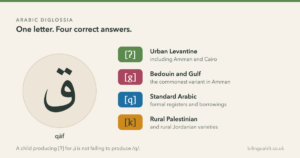
The interdentals are where most clinical error happens, so they are worth getting right. Bedouin and Bedouin-origin dialects, most of the Arabian Peninsula including Yemeni varieties, Muslim gilit Iraqi, rural central Palestinian and Jordanian, and the city dialects of Tunis, Mosul and Mardin all retain /θ/ and /ð/ [2, 4]. Sedentary Egyptian including Cairene, urban Levantine, Hijazi and Moroccan Arabic have merged them to dental stops [2, 4]. Northern Mesopotamian varieties use sibilants, and urban Egyptian and Levantine speakers use sibilants specifically in Standard Arabic borrowings, so the same Damascene speaker may produce both [t] and [s] reflexes depending on a word’s history [4].
National labels predict this badly. In Gaza City, 32 speakers overwhelmingly favoured the stop, with [θ] surviving only in formal borrowings, while in a nearby refugee camp elderly speakers retained the interdentals and younger ones had replaced them [5]. In Amman, a dialect formed from Jordanian and urban Palestinian input, second-generation speakers mix interdentals and stops, and by the third generation stops dominate in both genders [6]. Two children whose families both say they are Jordanian can have opposite inventories. For the Arabic sounds that have no close English equivalent, see Arabic speech sounds for English-speaking clinicians.
Common patterns, and what they do and do not tell you
English /p/. Where a child’s variety lacks /p/, [b] is the expected production. The strongest quantified evidence is from adults rather than children: 24 Najdi Saudi speakers identified English /p/ correctly in 59% of real words against a higher rate for /b/, and discriminated it at 62% against 79% [7]. Treat that as indicative of the difficulty, not as a developmental norm.
English /v/. The same study found /v/ identified at 68% against 88% for /f/ [7]. A separate study of Saudi learners in London found English /ð/ misheard as /v/ in 8 to 9% of responses [8], which matters because a child producing [v] for the may be doing something other than the familiar English developmental [d].
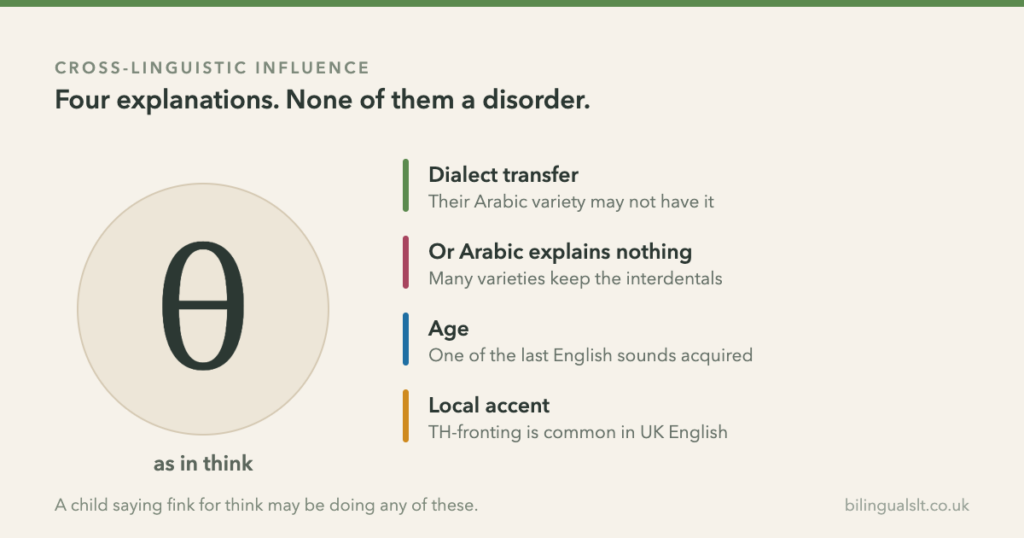
English /θ/ and /ð/. Here the clinical reasoning has to work harder, because three separate explanations compete. If the child’s variety lacks the interdentals, transfer predicts [t] or [d]. If the variety has them, transfer predicts nothing at all. And independently of Arabic, these are the last consonants monolingual English children acquire: in a British sample of 684 children, /r, θ, ð/ were acquired last, and in the 5;6 to 6;11 group 25% of girls and 39% of boys still produced /θ/ in error [9]. Cross-linguistic reviews place English /θ/ at 6;0 to 6;11 and /ð/ at 5;0 to 5;11 [10], with the 90% criterion for /θ/ not reached until around 77 months [11]. A five year old producing /θ/ inaccurately is inside monolingual English expectations before Arabic is considered at all.
Add a fourth possibility in the UK. Labiodental realisation of /θ/ is an established or spreading community feature across much of urban British English, documented in London, Reading, Milton Keynes, Hull, Derby and Middlesbrough, and more recently Edinburgh [12, 13]. A child in south London saying fink may simply be speaking like everyone around them.
Consonant clusters and vowels. Vowel insertion in English clusters is commonly attributed to Arabic syllable structure, and Syrian normative work treats epenthesis as a feature of typical speech rather than an error pattern [14]. Vowels deserve particular caution: phonological skills are not evenly distributed across a bilingual child’s two languages, and vowels differ more across languages than consonants, making them a likelier site of carryover [15].
Difference or disorder
The most useful distinction in the literature is not between languages but between shared and unshared sounds. In nine Algerian Arabic-French bilingual three year olds in Montreal, accuracy on consonants shared by both languages averaged 81.4% in French and 79.1% in Arabic, while language-specific consonants reached only 44.4% and 26.1%. No unshared consonant met the 75% acquisition threshold in either language [16]. The authors propose a heuristic worth borrowing: difficulty confined to a language’s unshared sounds may reflect slower additional-language learning, whereas difficulty affecting shared sounds as well may point to an underlying disorder. They are also careful to classify several Arabic patterns, including emphatics replaced by non-emphatics, as within-language developmental patterns reported in monolingual Arabic speakers rather than as transfer.
The both-languages principle is the other anchor. Signs of disorder should appear across all the languages a child uses [1], but that does not mean identical errors. A study of 18 Spanish-English children with speech sound disorder found significant between-language differences in vowel accuracy, in two manner classes and in four phonological patterns [15]. The RCSLT’s own bilingual best practice guidance puts it precisely: children with a speech disorder have the same type of disorder in both languages, and no child has been described with a delay in one language and a disordered pattern in the other, though surface error patterns may differ [17].
| What you observe | What to investigate |
|---|---|
| Substitution occurs only in English, on a sound absent from the child’s variety | Exposure, acquisition, and whether contrast is emerging |
| Difficulty affects sounds shared by both languages | Stronger indication of an underlying difficulty [16] |
| Error pattern appears in Arabic and English but differs in form | Still consistent with disorder; type matters more than surface form [15, 17] |
| Pattern matches the local English community accent | Accent, not transfer and not disorder [12, 13] |
| Inconsistent whole-word production across repetitions | Consider inconsistent phonological disorder in both languages |
Two honest limits. There is no published decision tree specific to Arabic-English bilingual children, and the only Arabic-specific framework available covers Saudi and Gulf dialects [18], which may not transfer to a UK caseload drawn largely from Levantine, Egyptian, Iraqi and Sudanese backgrounds. And the commercial difference-versus-disorder checklists that dominate search results are not peer-reviewed instruments.
Assessing an Arabic-English bilingual child
- Establish the specific variety and the family’s own migration and dialect history, not just the country. Where the family has moved between a rural and an urban area, ask which they speak.
- Sample both languages. In four Vietnamese-English children, English-only assessment diagnosed all four with speech sound disorder; assessment in both languages diagnosed two [19].
- Assess one language per session, using different pictures for the same targets so the child stays in the target language [17].
- Use the parents’ own productions as the adult model, which establishes the real local target rather than the Standard Arabic one [20].
- Sort errors into three bins: typical developmental errors for that language, errors explained by the other language, and errors that remain [20].
- Do not score between-language or dialect patterns as errors, and do not compare the child to monolingual peers to judge ability in either language [21].
- Where the profile is typical in one language and concerning in the other, the defensible decision is review rather than diagnosis or discharge [20].
On standardised English tests, one finding cuts against a blanket rule. In 44 children, percentage of consonants correct revised performed comparably for monolingual and bilingual English speakers at age 5;0, though the authors advise checking younger children for misdiagnosis risk [22]. The problem is less the measure than the interpretation layered on top of it.
Two worked examples
A child says [b] for /p/ in pig. If the family speaks a variety without /p/, this is the predicted transfer pattern and tells you very little by itself. The useful questions are whether the contrast appears anywhere, whether the child is stimulable for /p/, how long they have had English, and whether the rest of the system is intact. If /p/ is the only difficulty, this looks like additional-language learning. If shared sounds are also affected, that is a different picture [16].
A child says [s] for /θ/ in think. This one has no default reading. If the child’s variety retains the interdentals, Arabic does not explain it. If the variety uses sibilant reflexes in borrowed vocabulary [4], it might. If the child is five, monolingual English norms do not expect mastery yet [9, 10, 11]. And if they are growing up in a TH-fronting community, the ambient accent is in play too [12, 13]. Four possible explanations, none of them disorder, and all of them worth ruling in or out before the word error goes in a report.
How this relates to Arabic diglossia
These are two different things that often get collapsed. Diglossia is the distance between a child’s spoken Arabic and Modern Standard Arabic, which matters when assessment materials are written in the standard variety. Cross-linguistic influence is the interaction between Arabic and English. A child can be affected by both at once, and the combination is why an Arabic-English bilingual child’s profile has three moving parts rather than two. Arabic diglossia and its impact on speech and language assessment covers the first in detail.
A clinical perspective
I grew up in Amman speaking a mixture of Palestinian and Jordanian Arabic, predominantly Ammani Jordanian, and have assessed around 200 Arabic-speaking children in Jordan. When I assess children who speak varieties I am less familiar with, I use dialect-specific resources, consult speakers of that variety, and read up on its phonological patterns before I interpret anything as an error.
My MSc research looked at English phonological processes in 22 Arabic-English bilingual children aged 3;0 to 7;0 in West Amman [23]. Two findings shaped how I now think about this. Voiced /ð/ was replaced by /d/ in 100% of word-initial cases across ten children, mirroring the Jordanian Arabic pronunciation of ذهب as dahab rather than /ðahab/. That is dialect transfer behaving exactly as predicted. But /θ/ was replaced by /f/ in 71.4% of word-initial cases, which Jordanian Arabic does not predict at all, since the dialect substitutes /t/. Knowing a child’s variety tells you what to expect. It does not tell you what you will get, and the gap between those two things is where careful assessment lives.
Frequently asked questions
Does speaking Arabic cause speech sound errors in English? No. Influence from one language on another is a normal feature of bilingual development and is not a disorder [1]. It may produce differences from monolingual English norms, which is not the same thing.
Is replacing English /p/ with [b] a speech disorder? Not on its own. Where the child’s Arabic variety lacks /p/, this is the expected pattern. Look at whether shared sounds are also affected before drawing conclusions [16].
Why might an Arabic-speaking child say /s/ instead of /θ/? There are several possible reasons, including the child’s specific variety, age, English exposure and local accent. Many Arabic varieties contain /θ/, so Arabic influence should not be assumed [2, 4].
Can a bilingual child have a speech sound disorder in only one language? Signs should be evident across all their languages, though the surface errors may differ [15, 17]. A profile that is typical in one language and concerning in the other warrants review rather than a diagnosis [20].
Should Arabic-English bilingual children be assessed in both languages? Yes. English-only assessment has been shown to over-identify disorder in bilingual children [19], and assessing a single language risks misdiagnosis [20].
Key takeaways
An English production that differs from monolingual norms needs four questions before it becomes a clinical finding: is it expected in this child’s specific Arabic variety, is it age-appropriate for English, does it match the local accent, and does it affect sounds shared by both languages or only English-specific ones. Arabic is not a single inventory, English interdentals are late for everyone, and transfer is a normal property of two interacting systems rather than a deficit. The evidence base for Arabic-English specifically is thin, consisting largely of small case studies, so clinical reasoning has to carry more weight here than any published norm.
Where to go next
- Speech Sound Disorders: Learn, Differentiate, Treat — Pages on identifying and treating speech sound disorders, with interactive comparison and approach tools. The pages are free to read; most Differential Tool comparisons, the Approach Finder with your own findings and the two printables need a free account.
- Speech sound disorders: types, features and how they differ — Each type, its key features and how they differ. The page is free to read; only the printable needs a free account.
References
- American Speech-Language-Hearing Association. Speech sound disorders: articulation and phonology. ASHA Practice Portal. https://www.asha.org/practice-portal/clinical-topics/articulation-and-phonology/
- Watson, J. C. E. (2002). The Phonology and Morphology of Arabic. Oxford: Oxford University Press.
- Benkato, A. (2020). Maghrebi Arabic. In C. Lucas & S. Manfredi (Eds.), Arabic and Contact-Induced Change (pp. 197-212). Berlin: Language Science Press. https://doi.org/10.5281/zenodo.3744517
- Youssef, I. (2021). Contrastive feature typologies of Arabic consonant reflexes. Languages, 6(3), 141. https://doi.org/10.3390/languages6030141
- Cotter, W. M. (2016). One piece of the puzzle: notes on the historic interdental fricatives in the Arabic dialect of Gaza City. Journal of Arabic and Islamic Studies, 16, 149-162.
- Al-Wer, E. (2020). New-dialect formation: the Amman dialect. In C. Lucas & S. Manfredi (Eds.), Arabic and Contact-Induced Change (pp. 551-566). Berlin: Language Science Press. https://doi.org/10.5281/zenodo.3744549
- Alharbi, B., & Aljutaily, M. (2020). On the perceptual accuracy of non-native phonemic contrasts: a case study of native Arabic speakers. Journal of Language and Linguistic Studies, 16(4), 2003-2023. https://doi.org/10.17263/jlls.851031
- Evans, B. G., & Alshangiti, W. (2018). The perception and production of British English vowels and consonants by Arabic learners of English. Journal of Phonetics, 68, 15-31. https://doi.org/10.1016/j.wocn.2018.01.002
- Dodd, B., Holm, A., Hua, Z., & Crosbie, S. (2003). Phonological development: a normative study of British English-speaking children. Clinical Linguistics & Phonetics, 17(8), 617-643. https://doi.org/10.1080/0269920031000111348
- McLeod, S., & Crowe, K. (2018). Children’s consonant acquisition in 27 languages: a cross-linguistic review. American Journal of Speech-Language Pathology, 27(4), 1546-1571. https://doi.org/10.1044/2018_AJSLP-17-0100
- Crowe, K., & McLeod, S. (2020). Children’s English consonant acquisition in the United States: a review. American Journal of Speech-Language Pathology, 29, 2155-2169. https://doi.org/10.1044/2020_AJSLP-19-00168
- Cheshire, J., Gillett, A., Kerswill, P., & Williams, A. (1999). The Role of Adolescents in Dialect Levelling. Final report to the Economic and Social Research Council.
- Schleef, E., & Ramsammy, M. (2013). Labiodental fronting of /θ/ in London and Edinburgh: a cross-dialectal study. English Language & Linguistics, 17(1), 25-54. https://doi.org/10.1017/S1360674312000317
- Owaida, H. (2015). Speech Sound Acquisition and Phonological Error Patterns in Child Speakers of Syrian Arabic: A Normative Study. PhD thesis, City University London.
- Goldstein, B. A., & Gildersleeve-Neumann, C. E. (2015). Bilingualism and speech sound disorders. Current Developmental Disorders Reports, 2(3), 237-244. https://doi.org/10.1007/s40474-015-0049-3
- Meziane, R. S., & MacLeod, A. A. N. (2021). Evidence of phonological transfer in bilingual preschoolers who speak Arabic and French. International Journal of Bilingualism, 25(6), 1680-1695. https://doi.org/10.1177/13670069211034232
- Stow, C., & Pert, S. SLT Assessment and Intervention: Best Practice for Children and Young People in Bilingual Settings. Royal College of Speech and Language Therapists. https://www.rcslt.org/wp-content/uploads/media/Project/RCSLT/best-practice-cyp-bilingual-settings.pdf
- Abdulkader, D. M. (2026). Assessment of speech sound disorders in Saudi Arabic-speaking children and similar Gulf dialects: a tutorial for culturally responsive practice. Perspectives of the ASHA Special Interest Groups, 11(2), 511-530. https://doi.org/10.1044/2025_PERSP-25-00158
- Margetson, K., McLeod, S., & Verdon, S. (2024). Are English-only assessments sufficient? Diagnosing speech sound disorder in bilingual Vietnamese-English-speaking children. In E. Babatsouli (Ed.), Multilingual Acquisition and Learning (pp. 217-245). Amsterdam: John Benjamins. https://doi.org/10.1075/sibil.67.08mar
- Washington, K. N., Crowe, K., McLeod, S., Margetson, K., Bazzocchi, N. B. M., Kokotek, L. E., van der Straten Waillet, P., Másdóttir, T., & Volhardt, M. D. S. (2025). Methods of diagnosing speech sound disorders in multilingual children. Language, Speech, and Hearing Services in Schools, 56(3), 469-487. https://doi.org/10.1044/2025_LSHSS-24-00099
- Privette, C., & Fabiano-Smith, L. (2023). Assessing speech sound ability in bilingual children with diverse language experiences. EBP Briefs, 16(1), 1-9.
- Fabiano-Smith, L., & Hoffman, K. (2018). Diagnostic accuracy of traditional measures of phonological ability for bilingual preschoolers and kindergarteners. Language, Speech, and Hearing Services in Schools, 49(1), 121-134. https://doi.org/10.1044/2017_LSHSS-17-0043
- Imseeh, B. (2025). Beyond Monolingual Norms: English Phonology in Arabic-English Bilingual Children. Unpublished MSc dissertation, University of Sheffield.
About the author
Bodour Imseeh is a Speech and Language Therapist specialising in bilingualism, phonology, speech sound disorders and early literacy. She works across school-based and private caseloads and is fluent in Arabic and English. Read more on the About page.