By Bodour Imseeh, Speech and Language Therapist. Published 17 October 2026. Last clinically reviewed 17 October 2026.
A child referred for unclear speech chats fluently with her mother in the waiting room, then scores poorly on an Arabic assessment delivered in Modern Standard Arabic. Nothing about her language has changed between the corridor and the therapy room. What changed is the variety she was being asked to perform in, and whether the person scoring her knew the difference. Arabic is not one spoken language with one set of expectations, and treating it as though it were produces predictable errors in both directions. This article sets out what diglossia is, how it reaches into speech, vocabulary, grammar, phonological awareness and narrative assessment, and what to do differently when you interpret results.
Quick answer: how does Arabic diglossia affect speech and language assessment?
Arabic speakers use two varieties: a spoken dialect acquired naturally at home, and Modern Standard Arabic learned mainly through schooling. Assessment tasks built on Standard Arabic measure exposure to a formal register alongside underlying language ability. A low score may reflect either. Diglossia does not rule out genuine difficulty, but it does mean a Standard Arabic score cannot stand alone as evidence of disorder.
Key points
- Arabic dialects are systematic varieties, not degraded versions of Standard Arabic.
- No one speaks Standard Arabic at home as a first language.
- Scoring a child against Standard Arabic can mark a typical dialect form as an error.
- Diglossic distance affects children with and without DLD, and affects the DLD group more.
- Almost all the evidence comes from one dialect region, so transfer it cautiously.
What is Arabic diglossia?
Ferguson’s original 1959 description still holds. A diglossic community uses two varieties of one language with distinct functions: a “high” variety that is codified, prestigious and carries the written literature, and a “low” variety used for ordinary conversation. His point most worth repeating to clinicians is that the high variety “is not used by any sector of the community for ordinary conversation” and is learned mainly through formal education [1]. Arabic was one of his four defining cases.
In practice this means a child acquires their spoken variety the way any child acquires a first language, through interaction, while Standard Arabic arrives later through school, reading and media.
| Feature | Spoken Arabic | Modern Standard Arabic |
|---|---|---|
| Typical exposure | Home, peers, daily conversation | School, formal contexts, media |
| Acquisition | Naturalistic, from birth | Largely explicit, from school entry |
| Variation | Differs by region and community | Standardised across the Arab world |
The distance between the two is not trivial. In a corpus of roughly 4,500 word types from the spoken lexicon of Palestinian Arabic-speaking five year olds, only 21.2% of words were identical in form to their Standard Arabic equivalent; 40.6% were cognates with partially different phonological forms, and 38.2% were entirely different words [2]. On the morphological side, a mapping of 420 noun and verb morphemes found 81.4% were non-identical between spoken Palestinian and Standard Arabic, with verb inflection concentrated at the most distant end [3].
Why does it matter clinically?
The question is one of construct validity. If a task is delivered in Standard Arabic, a child’s score reflects both their language system and their exposure to a register they may barely have encountered. Those two things cannot be separated after the fact.
This is not hypothetical. A Lebanese-normed language screener applied to Arabic-German heritage bilingual children flagged 12 of 18 typically developing children as meeting criteria for DLD, while correctly identifying the children who did have it [4]. Over-identification on that scale is not a rounding error.
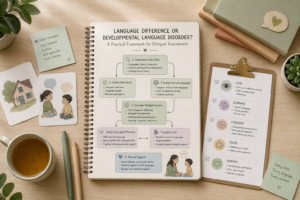
The reverse risk is equally real. A recent review of the diglossia literature warns that binary test designs can “inadvertently pathologize the language,” while also noting that dialect distance varies by region, so findings do not transfer uniformly [5]. Diglossia explains some low scores. It does not explain all of them, and a clinician who attributes everything to dialect will miss children who need help. For a wider framework, see Language Difference or Developmental Language Disorder?
Where diglossia touches assessment
Speech sound assessment
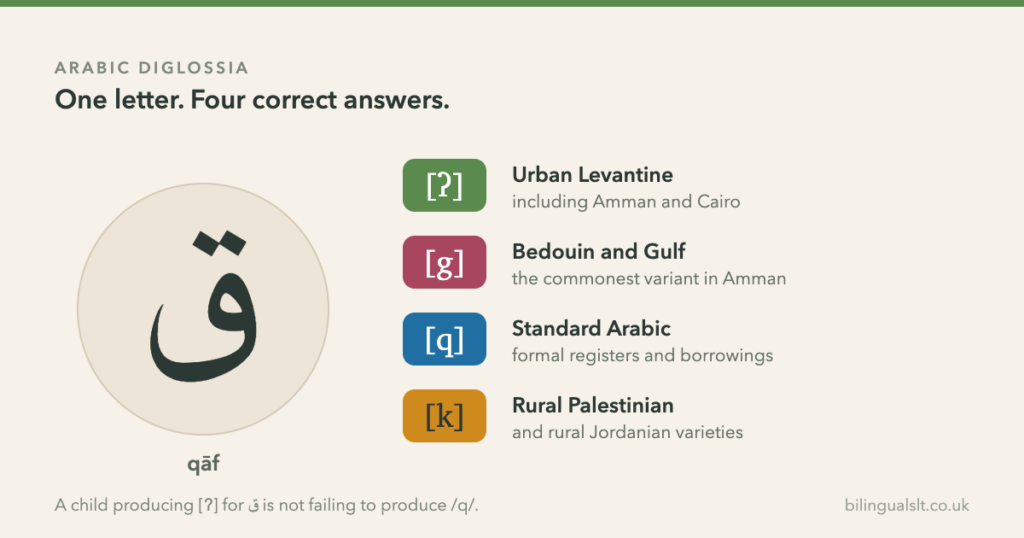
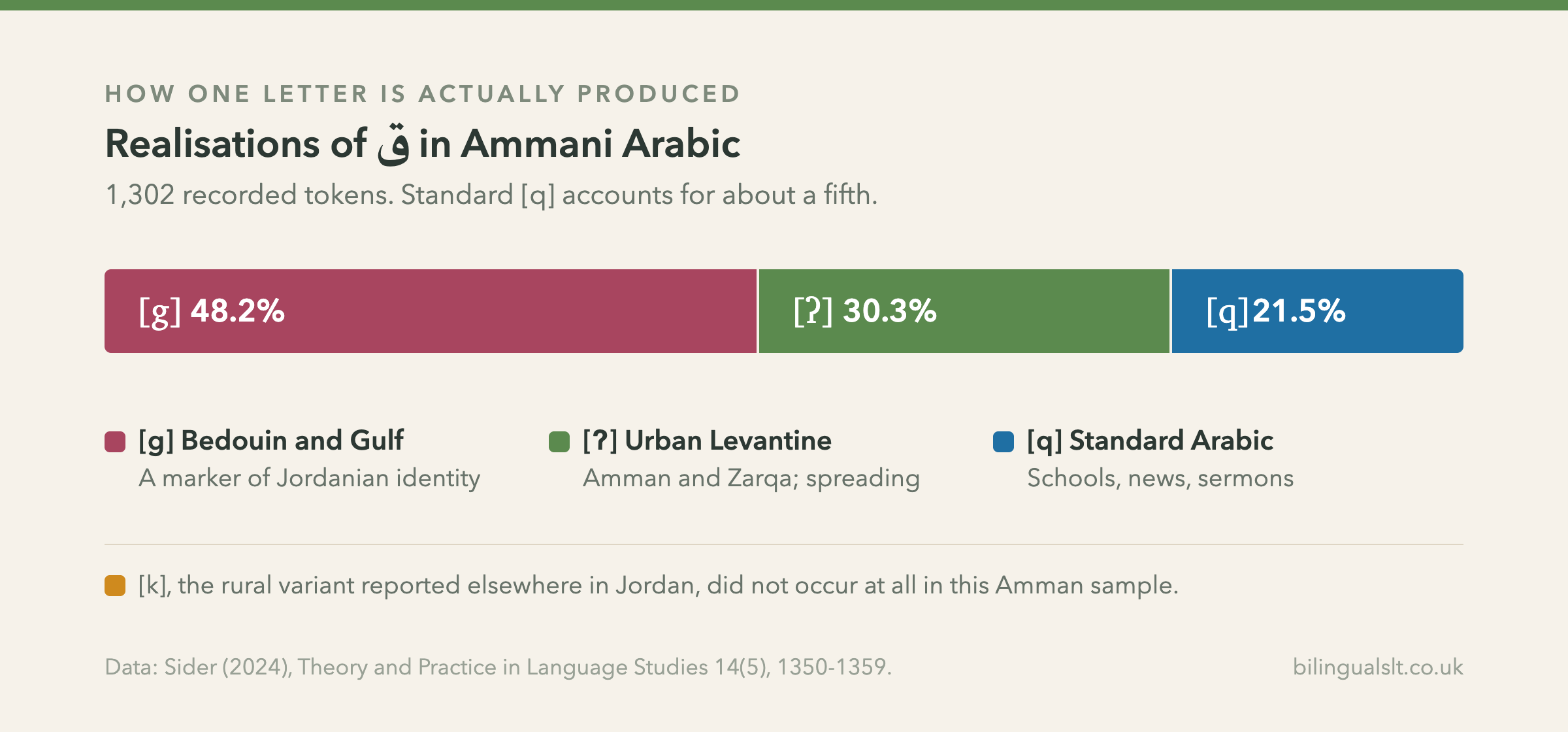
Dialects differ in which phonemes they contain and how shared phonemes are realised. The clearest example is ق. In Palestinian Arabic the variable has four variants, [ʔ], [k], [kˁ] and [g], with change running towards the urban [ʔ]; Standard [q] survives mainly in a closed set of borrowings such as /taqriːr/ “report” [6]. In an Ammani sample of 1,302 tokens, [g] accounted for 48.2% of productions, [ʔ] for 30.3% and [q] for 21.5%, patterning by setting, gender and education [7]. In Colloquial Egyptian Arabic, /q/ is commonly realised as /ʔ/, /dʒ/ as /g/ and /θ/ as /t/ [8].
A child producing [ʔ] for ق is not failing to produce /q/. They are producing the form their community uses. For consonant-by-consonant detail, see Arabic speech sounds for English-speaking clinicians, which includes a page on qāf.
Register matters as much as inventory. Amayreh followed up the ten consonants not yet acquired by 6;4 in Jordanian children and found that five were still not acquired in their Standard Arabic form even in the oldest children tested at 8;4, while eight were produced in acceptable colloquial forms by 7;4 [9, 10]. A companion study of 100 Jordanian school-entry children found all consonants of Jordanian Spoken Arabic acquired, with six of the consonants not acquired in Standard Arabic having dialectal equivalents [11]. The same child is late or on target depending on which register you score. Froud and Khamis-Dakwar make the broader point that much of the Arabic phonology literature has examined children’s production of formal Arabic, including sounds their native dialects do not contain [12].
Vocabulary
Given the lexical distance figures above, an Arabic receptive vocabulary item in Standard Arabic may be unfamiliar in form while the concept behind it is perfectly well known. Saiegh-Haddad and Haj’s three-way typology is the most useful framework here: words are identical, cognate or unique across the two varieties, with cognates further graded by distance. Across kindergarten to Grade 6, distance affected accuracy at every grade, and cognates differing by more than a single vowel behaved like entirely unfamiliar words [13].
Morphology, syntax and sentence repetition
Spoken varieties and Standard Arabic differ in verb morphology, agreement and word order. Saudi colloquial marks future with a bi- prefix or raħ rather than Standard sa-/sawfa, and uses one plural suffix where Standard Arabic distinguishes masculine from feminine [14]. SVO is the neutral order in modern dialects while VSO is unmarked in Standard Arabic.
Sentence repetition works well in Arabic when it is built in the right variety. A Palestinian Arabic task of 72 sentences achieved 93% sensitivity and 93% specificity with an AUC of .97 for identifying DLD in children aged 4;0 to 6;10, with dialectal variation in word production deliberately not scored as an error [15]. An Arabic nonword repetition task from the same team reached 93% sensitivity and specificity [16]. Note the scope: these are Palestinian Arabic instruments, validated in Ramallah. There is no validated Jordanian or Egyptian equivalent.
One finding should stop any neat story. In a grammaticality judgement study with 60 children in Nazareth, performance was better on colloquial items overall, except for negation, where children judged Standard Arabic items more accurately than their own dialect [17]. Influence runs both ways.
Phonological awareness and literacy
This is the best-evidenced area. Phonemes belonging to Standard Arabic only are consistently harder for children to isolate than phonemes present in their dialect. In one study, phoneme affiliation produced a significant effect, F(1, 64) = 29.62, p < .001; isolating a Standard Arabic phoneme in initial position scored 3.45 out of 10 in kindergarten against 7.47 in Grade 1 [18]. A subsequent design using two vernaculars that differed in whether they contained the critical phonemes isolated the effect cleanly, supporting a linguistic affiliation constraint [19]. The pattern held across 200 children from Grade 2 to Grade 10 [20].
Crucially for clinicians, this interacts with disorder rather than simply masking it. In 100 children repeating words and nonwords, items containing a Standard Arabic phoneme absent from the dialect showed a strong effect on performance, and that effect was stronger in the group with DLD [21]. A word-learning study from the same group found the DLD group’s vulnerability to phonological distance persisted a year longer than the typically developing group’s [22].
Narrative
The Arabic adaptation of MAIN deliberately uses dialect for everything addressed to the child, including instructions, prompts and comprehension questions, reserving Standard Arabic for protocols and headings. Its authors warn against using the Lebanese, Palestinian, Syrian or Iraqi versions with children speaking markedly different dialects, and report excluding Sudanese and Maghrebi data because of misunderstandings [23]. That caution is the honest position on cross-dialect transfer generally.
When dialect differences look like difficulties
| If the child | Consider | Before concluding |
|---|---|---|
| Produces [ʔ] or [g] for ق | The realisation in their specific variety | Speech sound disorder |
| Does not recognise a Standard Arabic word | Lexical distance and exposure | Receptive vocabulary difficulty |
| Uses a dialectal verb or plural form | Grammaticality within that variety | Morphosyntactic impairment |
| Struggles with Standard Arabic phoneme isolation | Phonological distance and literacy experience | A phonological awareness deficit |
What to do instead
- Record the child’s specific spoken variety, not “Arabic”. Urban Ammani, rural Jordanian and Gulf varieties differ in ways that change what counts as an error.
- Establish exposure to Standard Arabic separately: years of schooling, reading, Qur’anic instruction, media.
- Match the variety to the task. Khamis-Dakwar and Makhoul describe three defensible positions: Standard Arabic only, spoken Arabic only, and modality-matched, using the spoken variety for oral tasks and Standard Arabic for written ones [24].
- Do not assume norms transfer between varieties. When the Arabic CDI was standardised across Egypt, Jordan and Palestine, the authors found a single pan-Arabic word list had limits and computed norms separately by country, reversing their own earlier conclusion [25]. For speech sounds, I have collected the available consonant norms by region into short reference sheets: Levantine (Jordanian and Syrian), Colloquial Egyptian, and Gulf and Saudi, the last of which sets out what is not yet known and how to assess without published norms.
- Interpret standardised scores within their validation limits. ASHA’s position is that standardised scores “are not valid and are not reported for an individual who is not reflected in the normative sample,” though the items may still yield useful descriptive information as informal probes [26].
- Use dialect-appropriate language sampling and dynamic assessment where no normed instrument fits.
- Write the limitation into the report. State which variety you assessed in, which you did not, and what remains uncertain.
Where you do not share the child’s variety, work with a trained interpreter or a dialect-competent colleague, and brief them on which responses should count as acceptable. If you need a picture-naming starting point, my Arabic Phonology Screen (APS) includes a pronunciation-guide scoresheet with IPA and plain respellings, so you can score alongside an interpreter without reading Arabic. Pair it with the dialect-scoring guidance in the norms sheets, so a typical dialect form is not marked as an error.
Arabic-English bilingual children
For an Arabic-English bilingual child, three systems interact: the spoken variety, Standard Arabic and English. Exposure, dominance and literacy instruction may differ across all three, so Standard Arabic performance is a poor proxy for overall Arabic ability.
Dialect also reaches into English. In my own study of 22 Arabic-English bilingual children aged 3;0 to 7;0 in West Amman, /ð/ was replaced by /d/ in 100% of word-initial cases across ten participants, mirroring the Jordanian Arabic pronunciation of ذهب as dahab rather than /ðahab/ [27]. But the same study found /θ/ replaced by /f/ in 71.4% of word-initial cases, which Jordanian Arabic does not predict, since the dialect substitutes /t/. Knowing the dialect tells you what to expect. It does not tell you what you will get.
A clinical perspective
I grew up in Amman speaking a mixture of Palestinian and Jordanian Arabic, predominantly Ammani Jordanian, and have assessed around 200 Arabic-speaking children in Jordan. I have seen a child using the glottal stop [ʔ] for ق described as unable to produce /q/, when [ʔ] is a typical realisation of that sound in their spoken dialect. When I assess children who speak varieties I am less familiar with, I use dialect-specific resources, consult speakers of that variety, and read up on its phonological patterns before I interpret anything as an error. That is a clinical practice rather than a research finding, but it has stopped me being wrong more than once.
Frequently asked questions
Does Arabic diglossia cause speech or language disorders? No. Diglossia is a feature of the language situation, not a risk factor. It complicates assessment because it creates a gap between the variety a child speaks and the variety many tasks are written in.
Can Standard Arabic assessments be used with children who speak dialects? Only with care, and not as the sole evidence. Most published Arabic language and reading tests use Standard Arabic, which is problematic when children are acquiring two systems at once [24]. Items can still be useful as informal probes [26].
How do I tell a dialect difference from a speech sound disorder? Establish the child’s variety first, then check whether the production is the expected realisation in that variety. A Syrian normative study makes the point directly: applying norms from another variety such as Jordanian may lead to incorrect diagnosis [28].
Should Arabic-speaking children be assessed in their home dialect? For oral language, generally yes. The Arabic MAIN adaptation and the validated Palestinian repetition tasks are both built in dialect for exactly this reason [15, 23].
How does diglossia affect phonological awareness? Phonemes that exist only in Standard Arabic are consistently harder to isolate and manipulate than phonemes present in the child’s dialect, from kindergarten through secondary school [18, 19, 20].
Key takeaways
Arabic cannot be treated as a single spoken variety in assessment. A child’s performance on a Standard Arabic task reflects their exposure to a formal register as well as their language ability, and those cannot be separated after scoring. Establish the specific variety, match the task to it where you can, and interpret standardised scores within the population they were normed on. One caution about the evidence itself: a 2025 review found only twelve eligible studies, drawn overwhelmingly from Palestinian Arabic speakers in northern Israel, and noted that Levantine varieties sit closest to Standard Arabic while North African varieties sit furthest [5]. For a Moroccan or Sudanese child, these findings are a starting point, not a norm.
References
- Ferguson, C. A. (1959). Diglossia. Word, 15(2), 325-340. https://doi.org/10.1080/00437956.1959.11659702
- Saiegh-Haddad, E., & Spolsky, B. (2014). Acquiring literacy in a diglossic context: problems and prospects. In E. Saiegh-Haddad & R. M. Joshi (Eds.), Handbook of Arabic Literacy (pp. 225-240). Springer. https://doi.org/10.1007/978-94-017-8545-7_10
- Joubran-Awadie, N., & Shalhoub-Awwad, Y. (2023). Morphological distance between spoken Palestinian dialect and standard Arabic and its implications for reading acquisition. First Language, 43(2), 200-230. https://doi.org/10.1177/01427237221145375
- Abed Ibrahim, L. (2025). Assessment of heritage language abilities in bilingual Arabic-German children with and without developmental language disorder. Journal of Speech, Language, and Hearing Research, 68(3S), 1569-1601. https://doi.org/10.1044/2024_JSLHR-23-00617
- Bergstrand Othman, L. (2025). Arabic diglossia: advocating for a non-deficit model in comparative analysis of reading and language acquisition. Frontiers in Education, 10, 1518728. https://doi.org/10.3389/feduc.2025.1518728
- Al-Wer, E., Horesh, U., Herin, B., & De Jong, R. (2022). Arabic Sociolinguistics. Cambridge University Press. https://doi.org/10.1017/9781316863060
- Sider, L. M. A. (2024). The impact of three social factors on the variation of “Qaf” in Ammani Arabic. Theory and Practice in Language Studies, 14(5), 1350-1359. https://doi.org/10.17507/tpls.1405.07
- Elrefaie, D. A., Hegazi, M. A. E. F., El-Mahallawi, M. M., & Khodeir, M. S. (2021). Descriptive analysis of the development of the Arabic speech sounds among typically developing colloquial Egyptian Arabic-speaking children. The Egyptian Journal of Otolaryngology, 37, 38. https://doi.org/10.1186/s43163-021-00094-w
- Amayreh, M. M., & Dyson, A. T. (1998). The acquisition of Arabic consonants. Journal of Speech, Language, and Hearing Research, 41(3), 642-653. https://doi.org/10.1044/jslhr.4103.642
- Amayreh, M. M. (2003). Completion of the consonant inventory of Arabic. Journal of Speech, Language, and Hearing Research, 46(3), 517-529. https://doi.org/10.1044/1092-4388(2003/042)
- Hamdan, J. M., & Amayreh, M. M. (2007). Consonant profile of Arabic-speaking school-age children in Jordan. Folia Phoniatrica et Logopaedica, 59(2), 55-64. https://doi.org/10.1159/000098338
- Froud, K., & Khamis-Dakwar, R. (2021). The study of Arabic language acquisition. In K. Ryding & D. Wilmsen (Eds.), The Cambridge Handbook of Arabic Linguistics (pp. 48-82). Cambridge University Press. https://doi.org/10.1017/9781108277327.004
- Saiegh-Haddad, E., & Haj, L. (2018). Does phonological distance impact quality of phonological representations? Evidence from Arabic diglossia. Journal of Child Language, 45(6), 1377-1399. https://doi.org/10.1017/S0305000918000302
- Alharbi, D. H., Clegg, J., & Öztürk, Ö. (2024). Comprehension of verb morphology in Arabic-speaking children with and without developmental language disorder. Clinical Linguistics & Phonetics, 39(6-8), 677-703. https://doi.org/10.1080/02699206.2024.2394544
- Taha, J., Stojanovik, V., & Pagnamenta, E. (2021). Sentence repetition as a clinical marker of developmental language disorder: evidence from Arabic. Journal of Speech, Language, and Hearing Research, 64(12), 4876-4899. https://doi.org/10.1044/2021_JSLHR-21-00244
- Taha, J., Stojanovik, V., & Pagnamenta, E. (2021). Nonword repetition performance of Arabic-speaking children with and without developmental language disorder: a study on diagnostic accuracy. Journal of Speech, Language, and Hearing Research, 64(7), 2750-2765. https://doi.org/10.1044/2021_JSLHR-20-00556
- Khamis-Dakwar, R., Froud, K., & Gordon, P. (2012). Acquiring diglossia: mutual influences of formal and colloquial Arabic on children’s grammaticality judgments. Journal of Child Language, 39(1), 61-89. https://doi.org/10.1017/S0305000910000784
- Saiegh-Haddad, E. (2004). The impact of phonemic and lexical distance on the phonological analysis of words and pseudowords in a diglossic context. Applied Psycholinguistics, 25(4), 495-512. https://doi.org/10.1017/S0142716404001249
- Saiegh-Haddad, E. (2007). Linguistic constraints on children’s ability to isolate phonemes in Arabic. Applied Psycholinguistics, 28(4), 607-625. https://doi.org/10.1017/S0142716407070336
- Saiegh-Haddad, E., Shahbari-Kassem, A., & Schiff, R. (2020). Phonological awareness in Arabic: the role of phonological distance, phonological-unit size, and SES. Reading and Writing, 33, 1649-1674. https://doi.org/10.1007/s11145-020-10019-3
- Saiegh-Haddad, E., & Ghawi-Dakwar, O. (2017). Impact of diglossia on word and non-word repetition among language impaired and typically developing Arabic native speaking children. Frontiers in Psychology, 8, 2010. https://doi.org/10.3389/fpsyg.2017.02010
- Ghawi-Dakwar, O., & Saiegh-Haddad, E. (2025). Word learning in Arabic diglossia in children with typical language development and developmental language disorder. Journal of Speech, Language, and Hearing Research, 68(3S), 1533-1551. https://doi.org/10.1044/2024_JSLHR-23-00618
- Bohnacker, U., & Haddad, R. (2020). Adapting MAIN to Arabic. ZAS Papers in Linguistics, 64, 1-10.
- Khamis-Dakwar, R., & Makhoul, B. (2014). The development of ADAT (Arabic Diglossic Knowledge and Awareness Test): a theoretical and clinical overview. In E. Saiegh-Haddad & R. M. Joshi (Eds.), Handbook of Arabic Literacy (pp. 279-300). Springer. https://doi.org/10.1007/978-94-017-8545-7_13
- Abdelwahab, A., Floccia, C., Forbes, S., Alsiddiqi, Z., Al-Shdifat, K., McKean, C., Odeh, T., Trebacz, A., & Khattab, G. (2025). Adaptation and standardization of two Arabic communicative development inventories for children aged 8 to 30 months and 30 to 48 months in Egypt, Jordan and Palestine. Journal of Speech, Language, and Hearing Research, 68(7), 3239-3290. https://doi.org/10.1044/2025_JSLHR-24-00534
- American Speech-Language-Hearing Association. Multilingual service delivery in audiology and speech-language pathology. ASHA Practice Portal. https://www.asha.org/practice-portal/professional-issues/multilingual-service-delivery/
- Imseeh, B. (2025). Beyond monolingual norms: English phonology in Arabic-English bilingual children. Unpublished MSc dissertation, University of Sheffield.
- Owaida, H. (2015). Speech sound acquisition and phonological error patterns in child speakers of Syrian Arabic: a normative study. PhD thesis, City University London.
About the author
Bodour Imseeh is a Speech and Language Therapist specialising in bilingualism, phonology, speech sound disorders and early literacy. She works across school-based and private caseloads and is fluent in Arabic and English. Read more on the About page.