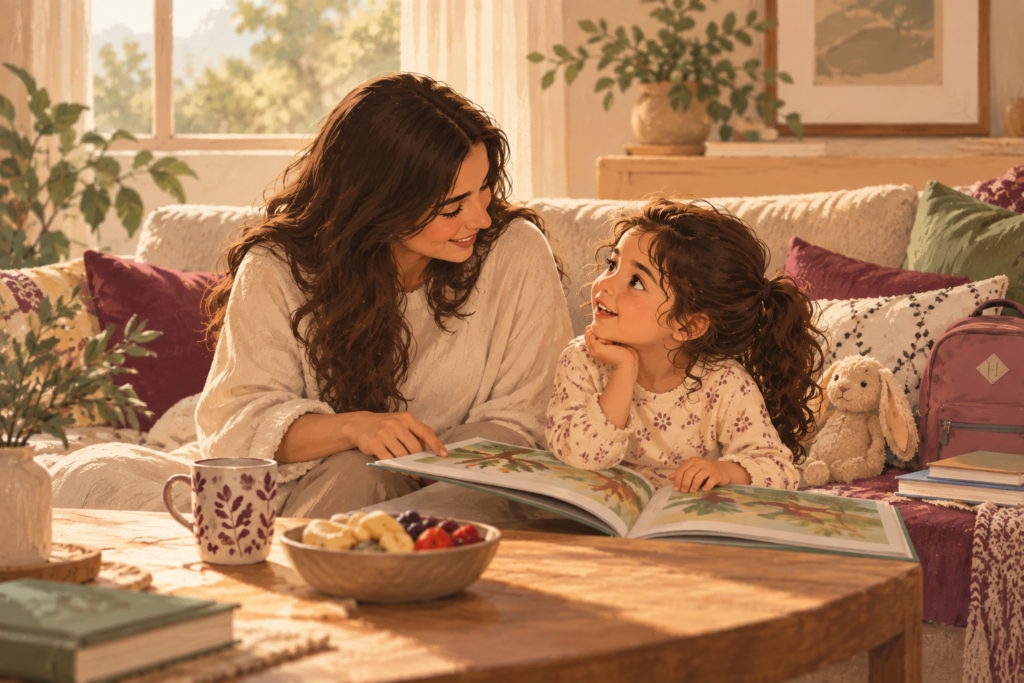
Why keeping your home language can support your child’s communication, learning and family relationships.
The short answer: no, you do not need to stop speaking Arabic
If Arabic is the language you speak most naturally and comfortably with your child, there is generally no reason to replace it with English.
Professional guidance is clear that bilingualism does not cause or contribute to speech, language or communication difficulties.[1] Researchers who study bilingual development put it just as plainly: immigrant parents should not be discouraged from speaking their first language to their children.[2] The American Academy of Pediatrics tells families that using your own language will not confuse your child, hold them back academically, or stop them learning English.[3]
The rest of this article is about why, and about the situations where parents most often get told otherwise.
Will speaking Arabic at home make it harder for my child to learn English?
No, and the distinction here is worth getting right, because it is where most of the worry comes from.
There is a real relationship between how much of a language a child hears and how quickly that language develops. In a study following Spanish-English bilingual toddlers, the proportion of input in each language predicted vocabulary and grammar in that language. More English input meant faster English growth; more Spanish input meant faster Spanish growth.[4]
That sounds alarming until you notice what it is actually saying. Less English exposure means less English. It does not mean Arabic is interfering with English, or competing with it, or taking up space English needs. Those are different claims, and only the first one is supported.
The same study found that when researchers counted words across both languages together, the bilingual children knew about as many as the monolingual children.[4] They were not learning less. They were spreading what they learned across two systems.
So the honest version is: your child’s English will develop in proportion to the English they get. The question is where that English is going to come from.
But my child needs English for nursery or school
This worry makes complete sense. You want your child to understand their teacher, make friends and keep up. Nobody wants their child sitting confused in a classroom.
Here is the thing that often gets missed. Once your child starts at an English-medium nursery or school, their English exposure usually increases a great deal and keeps increasing. Lessons, playground, friends, homework, screens, and in time the language they reach for first. Many children from immigrant families start school with less English than their monolingual classmates.[5] That is expected when English has had less time, and it is not in itself a reason to drop Arabic.
Where that leaves Arabic depends on where you live. If you are raising your child in an English-speaking country, home may be close to the only place Arabic is heard at all. If you are in Amman or elsewhere in the region, Arabic has the whole community behind it, but English can still become the language your child prefers, uses with friends, and does their schoolwork and thinking in.
Either way, research on bilingual development shows that early exposure to two languages does not by itself guarantee both will develop well. How much of each language a child hears, the quality of it, and how much the child actually uses each language all shape what happens.[5]
That reframes the question. Once a child is in an English-medium setting, the language that usually needs deliberate attention is not English.
There is also something at stake beyond vocabulary counts. In a study of more than 620 adolescents from immigrant families, those who spoke the same language as their parents reported greater family cohesion and more discussion with them than those who ended up speaking different languages.[6] The ability to talk properly with your own child, about difficult things and not just about dinner, is worth protecting in its own right.
Wouldn’t speaking English at home give them more practice?
This one deserves a real answer rather than a slogan, because plenty of advice online tells parents to never speak English at home, and that is not quite right either.
If English is a language you genuinely use well and comfortably, you can absolutely use it with your child. The problem is not English. The problem is swapping rich, natural, fluent Arabic conversation for limited, effortful English because somebody told you it would help.
The research supports this distinction rather than a blanket rule. One study of bilingual toddlers found that how much of their English came from native speakers, and how many different people they heard it from, predicted their English over and above the sheer amount.[8] A later study looked more closely and found something more useful for parents: what mattered was not whether input came from native or non-native speakers, but how proficient the non-native speakers were.[7]
In other words, quality of input is what counts, and a parent’s own fluency is part of that quality. Very good English from a parent is good input. Halting, uncertain English that replaces warm and fluent Arabic is a downgrade, not an upgrade.
Ask yourself which language you can use to explain why the sky changes colour, comfort your child after a bad dream, tell a family story properly, or argue playfully about who ate the last biscuit. Use that one.
What if my child answers me in English when I speak Arabic?
This is extremely common and it is not a sign that you should switch.
Children respond in the language that feels easiest and most useful to them in that moment, and once school starts, English usually takes that position. Bilingual children are sensitive to who they are speaking with and adjust accordingly from very young.[9] Your child answering in English does not mean Arabic has stopped going in.
Keep speaking Arabic. Keep responding to what they meant rather than which language they said it in. You can model the Arabic version naturally without requiring them to repeat it back, which helps the conversation stay focused on communication rather than correction.
If you stop using Arabic at this point, the input stops. If you continue, your child keeps receiving it even during the phase when they mostly reply in English.
Hearing Arabic is only part of it. Children’s own use of a language also shapes how well they come to speak it.[5] So it helps to give Arabic real jobs to do: relatives who don’t use English, games, stories and outings where Arabic is genuinely the language that gets things done.
What if my child mixes Arabic and English in the same sentence?
Mixing languages, sometimes called code-switching, is a normal part of bilingual development. Bilingual children mix for sensible reasons, often reaching for the word they have when the other one has not arrived yet, and even toddlers adjust their language choice depending on who they are talking to.[9]
By itself, mixing is not evidence that your child is confused, and it is not a reason to drop a language.
What if my child has a speech or language delay?
This is the situation where families are most likely to be told to give up Arabic, and it is where that advice can be particularly harmful.
A child with a genuine communication difficulty still needs access to their languages. A review of research on bilingualism in children with developmental disorders found that simultaneous bilingual children performed similarly to, and on some measures better than, monolingual children with the same disorder when their stronger language or both languages were considered.[10] The review also found that parents of children with autism were often advised to use only the majority language, despite evidence that bilingual exposure itself did not disadvantage these children.
Professional guidance says the same. ASHA’s guidance on late language emergence states directly that becoming monolingual is not necessary and should not be advised as a response to a child being late to talk.[11]
The point worth holding onto: removing Arabic does not treat a language disorder. It removes a language. A genuine language disorder is not caused by Arabic and will affect a child’s ability to learn and use language across their languages, although the difficulties may look different in each one.
What should happen instead is an assessment that looks at your child’s skills across all their languages, rather than judging them through English alone.[12]
What if a teacher or professional tells me to speak only English?
You are allowed to ask why.
A recommendation to stop using your home language should come with a clear, evidence-based reason. RCSLT’s 2006 guidelines, as quoted by Stow and Pert, warned that bilingual individuals may be vulnerable to well-meaning but ill-informed professionals who advise abandoning the mother tongue.[13] The advice is usually offered kindly. That does not make it correct.
Some useful things to ask:
- What specifically would improve if we stopped speaking Arabic?
- Has my child’s Arabic been looked at, or only their English?
- Is this based on assessment of both languages?
- What is the plan for supporting English directly, rather than by removing Arabic?
If your child needs more English, the answer is usually more and better English input from settings and people who can provide it well, not less Arabic from the people who love them.
So what language should I actually speak to my child?
Use the language or languages in which you can talk, play, joke, explain, comfort, tell stories and have real conversations most naturally.
You do not need a rigid system. Approaches such as one parent, one language work well for some families and are not required. What matters is that your child gets plenty of good-quality exposure to each language, and researchers reviewing this evidence conclude that parents should use whatever arrangement achieves that in their own household.[9] Guidance for parents says the same: speak to your child in the language you are most comfortable using.[14]
Practically, that usually looks like this:
- Speak Arabic when Arabic is your strongest and most natural language.
- Use English when you genuinely use English well and it fits the moment.
- Do not force yourself into a language that makes you a worse conversational partner.
- Let nursery and school provide much of the English exposure, particularly in an English-medium setting.
- Give Arabic deliberate attention rather than assuming it will look after itself.
The one thing to take away
Do not trade the quality of your communication for the quantity of English.
In an English-medium school and community, your child is likely to get increasing amounts of English. What they will not automatically get is a parent who can explain the world to them fluently, comfort them properly, and stay close to them as they grow. That comes from the language you actually have, spoken well.
Frequently asked questions
Can learning Arabic and English confuse my child?
No. Bilingualism does not cause speech, language or communication difficulties.[1] Children are capable of learning more than one language from birth, and mixing the two in a sentence is a normal part of that process rather than a sign of confusion.[9] Guidance for parents is clear that using your own language will not confuse your child or stop them learning English.[3]
Should we speak English at home before my child starts an English-speaking school?
You do not need to. In an English-medium school, English exposure usually rises substantially once school starts. If you want to prepare your child, playgroups, English-speaking friends and story sessions are good ways to add English from fluent speakers, rather than a parent switching into a language they use less comfortably. Research links children’s English to how much English they hear, how many different people they hear it from, and how proficient those speakers are.[7][8]
Should I speak English to my child if my English is not fluent?
You can, but you do not need to replace Arabic with English. The quality of the language children hear matters for their language development,[8] and one study found that how proficient a non-native speaker is mattered more than whether the input came from a native speaker at all.[7] If your English is limited, using it instead of fluent Arabic gives your child less to learn from, not more. Use English where it comes naturally, and keep Arabic for real conversation.
My child understands Arabic but only speaks English. What should I do?
Keep speaking Arabic. Understanding is real knowledge, and it is the foundation your child would need to start speaking Arabic again later. Children reply in whichever language feels easiest, which is usually the school language.[5] Model the Arabic version naturally rather than requiring them to repeat it back, so the conversation stays focused on communication rather than correction.
Can I speak Arabic while my partner speaks English?
Yes, and many families do exactly this. One parent, one language is one workable arrangement among several, not a requirement. Researchers reviewing the evidence advise using whatever arrangement gives your child plenty of good-quality exposure to each language in your particular household.[9] Whichever you choose, it works better if each parent is using a language they speak well.
Will speaking Arabic affect my child’s English pronunciation?
Your child may carry some sound patterns from their variety of Arabic into English. For example, depending on the dialect, English sounds such as /p/ or /v/ may be produced using a nearby Arabic sound. That is cross-linguistic influence, and it produces an accent or a predictable difference rather than a speech disorder.[12] If you are concerned that your child is genuinely hard to understand, that is worth assessing across both languages rather than English alone.[12]
Where to go next
- Family Language Planner — Work out which language each person uses, and when, in a way that fits your family.
- Raising a Bilingual Child — What’s typical, what’s a myth, and how to plan the languages in your home.
References
- Royal College of Speech and Language Therapists. Bilingualism. https://www.rcslt.org/speech-and-language-therapy/clinical-information/bilingualism/
- Hoff, E., & Core, C. (2015). What clinicians need to know about bilingual development. Seminars in Speech and Language, 36(2), 89–99. https://doi.org/10.1055/s-0035-1549104
- American Academy of Pediatrics. Young children learning multiple languages: parent FAQs. HealthyChildren.org. https://www.healthychildren.org/English/ages-stages/gradeschool/school/Pages/7-Myths-Facts-Bilingual-Children-Learning-Language.aspx
- Hoff, E., Core, C., Place, S., Rumiche, R., Señor, M., & Parra, M. (2012). Dual language exposure and early bilingual development. Journal of Child Language, 39(1), 1–27. https://doi.org/10.1017/S0305000910000759
- Hoff, E. (2018). Bilingual development in children of immigrant families. Child Development Perspectives, 12(2), 80–86. https://doi.org/10.1111/cdep.12262
- Tseng, V., & Fuligni, A. J. (2000). Parent-adolescent language use and relationships among immigrant families with East Asian, Filipino, and Latin American backgrounds. Journal of Marriage and the Family, 62(2), 465–476. https://doi.org/10.1111/j.1741-3737.2000.00465.x
- Unsworth, S., Brouwer, S., de Bree, E., & Verhagen, J. (2019). Predicting bilingual preschoolers’ patterns of language development: Degree of non-native input matters. Applied Psycholinguistics, 40(5), 1189–1219. https://doi.org/10.1017/S0142716419000225
- Place, S., & Hoff, E. (2011). Properties of dual language exposure that influence 2-year-olds’ bilingual proficiency. Child Development, 82(6), 1834–1849. https://doi.org/10.1111/j.1467-8624.2011.01660.x
- Byers-Heinlein, K., & Lew-Williams, C. (2013). Bilingualism in the early years: What the science says. LEARNing Landscapes, 7(1), 95–112. https://doi.org/10.36510/learnland.v7i1.632
- Kay-Raining Bird, E., Genesee, F., & Verhoeven, L. (2016). Bilingualism in children with developmental disorders: A narrative review. Journal of Communication Disorders, 63, 1–14. https://doi.org/10.1016/j.jcomdis.2016.07.003
- American Speech-Language-Hearing Association. Late language emergence (Practice Portal). https://www.asha.org/practice-portal/clinical-topics/late-language-emergence/
- American Speech-Language-Hearing Association. Multilingual service delivery in audiology and speech-language pathology (Practice Portal). https://www.asha.org/practice-portal/professional-issues/multilingual-service-delivery/
- Stow, C., & Pert, S. (n.d.). SLT assessment and intervention: Best practice for children and young people in bilingual settings. Royal College of Speech and Language Therapists. Quoting RCSLT (2006), Communicating Quality 3, p. 270. https://www.rcslt.org/wp-content/uploads/media/Project/RCSLT/best-practice-cyp-bilingual-settings.pdf
- The Hanen Centre. Speaking more than one language with my child. https://www.hanen.org/information-tips/speaking-more-than-one-language-with-my-child