Simple ways to support Arabic and English without turning home into a classroom.
The short answer: you do not need to “teach” two languages all day
Language grows through interaction, not through drilling vocabulary, working through flashcards or translating every sentence twice.
What your child needs is regular, meaningful chances to hear and use each language with people who care about them. That is it. And you almost certainly already have those chances, sitting inside the routines you do every single day.
Start with the routines you already have
You do not need to find an extra hour for “Arabic time.” Meals, bath time, getting dressed, the school run, shopping and bedtime happen anyway, and they have something classrooms struggle to manufacture: the same language, repeated, in a situation your child already understands.
The principle for all of it is simple.
Same routine + repeated language + real interaction.
The Hanen Centre’s advice for parents runs along the same lines: follow your child’s lead, respond straight away to what they offer, leave space for them to take a turn, and use everyday moments like play, bath time, meals and walks.[1]
Here is what that looks like in practice.
1. Getting dressed
Clothes, body parts, colours, actions, choices, where things are and what comes next. All of it, every morning, in roughly the same order.
The one shift worth making is from testing to talking. Compare:
Testing: “What’s this? What colour is it? Say jumper.”
Talking: “Your red jumper is under the bed. Let’s find it.”
The second gives your child the same words with none of the pressure, and it leaves room for them to say something back. Try it in Arabic too: «وين الكنزة الحمرا؟ تحت التخت. يلا نلاقيها.»
Comment on what is happening rather than quizzing. You will find you say more, and so will they.
2. Mealtimes
Meals are full of asking, choosing, describing, refusing and family talk. «بدك تفاحة ولّا موز؟» works just as well as “apple or banana?”
One thing worth saying clearly: you do not need to translate everything.
If you say something naturally in Arabic, you do not have to immediately repeat the whole sentence in English. Your child can often use the situation, your gestures and the conversation itself to work out what you mean. Let Arabic have moments where it stands on its own rather than automatically providing an English version every time.
3. The car or the school run
Songs, spotting things out of the window, talking about where you are going, guessing what will happen. The journey home is particularly good, because it is a natural moment for talking about things that already happened, which is harder language than naming what is in front of you.
You can also stretch the same routine as your child grows:
- “School.”
- “We’re going to school.”
- “What do you think you’ll do at school today?”
- “You said Sami was upset yesterday. What happened in the end?”
Same car, same trip, steadily more demanding language.
4. Shopping and errands
Out of the house is where bilingual life gets visible, and it is worth noticing that without treating it as something that needs correcting.
Your child might speak Arabic to their grandmother, switch to English when they bump into a school friend, and mix both when they turn back to you. That is not a failure to stick to a language. Bilingual children can adjust their language according to who they are talking to, and mixing languages is a normal part of bilingual development.[2]
You do not need to correct the switch or turn it into a test of which language they should be using. Keep the conversation going.
5. Play
If you only change one thing after reading this, change this one.
Follow what your child is already interested in, comment on what they are doing, and add a little to what they say. You do not need to ask them to repeat it.
Child: «سيارة كبيرة.»
You: «آه، سيارة كبيرة وسريعة!»
Child: “Dog sleeping.”
You: “Yes, the little dog is sleeping on the sofa.”
That is the whole technique. They give you something, you give it back slightly bigger. No correction, no demand, no “say it properly.”
Pretend play is especially useful because it invents reasons to talk: shops, doctors, cooking, driving somewhere. Give the game a language and let it run.
6. Books and story time
The most freeing thing to know about books is this: the language printed on the page does not decide the language of the conversation.
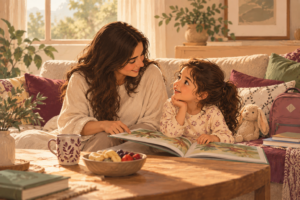
You can read an English book and talk about it entirely in Arabic. You can tell an Arabic story from memory with no book at all. You can skip most of the text and talk about the pictures instead.
That last option is not a lesser version of reading. A meta-analysis of studies comparing interactive book sharing with ordinary reading aloud found a moderate benefit for the words children actually said themselves, their expressive vocabulary, when adults talked with the child about the book rather than simply reading it, though the effect was smaller for older children and for those already at risk of language difficulties.[3]
So: ask what your child thinks will happen next, connect the story to something that happened to them, let them turn the pages and take the conversation somewhere else entirely. That is the good bit.
7. Songs, rhymes and family games
Parents routinely underestimate this as “not really language work.” It very much is.
Arabic nursery rhymes, clapping games, riddles, the sayings your own mother used, the songs you grew up with, stories your father tells about the village. These give children language they may not hear anywhere else: repeated phrases, humour, rhythm, cultural references and ways of telling stories that belong to their family.
It is also, frankly, the part of Arabic that no app will give your child.
8. Video calls with Teta and Jiddo
This deserves its own section, because it does something no other routine does: it creates a genuine reason to use Arabic.
There is a difference between requiring Arabic and creating a reason for Arabic. “Say hello to Teta in Arabic” is a demand. “Show Teta what you built” is a conversation that happens to need Arabic.
Give them something to actually do on the call. Show her a toy. Tell her what happened at school. Ask her a question. Describe the cake you made. Let her ramble.
There is also evidence that the number of people a child hears a language from may matter. In one study of 29 Spanish–English bilingual two-year-olds, hearing English from a greater number of different speakers was associated with stronger English skills, even after the researchers accounted for how much English the children heard.[4] The study did not establish the same effect for Spanish, so we should not assume that finding automatically generalises to every language. But it is another reason to think beyond worksheets: real relationships give children real people to communicate with.
9. Screens and Arabic media
Arabic cartoons, songs and audiobooks can add exposure, and they are not a problem. But it is worth being honest about what they do and do not do.
In a well-known study, nine-month-old babies who spent time with live Mandarin speakers kept the ability to hear Mandarin speech sounds. Babies given exactly the same material through video or audio recordings learned nothing from it.[5] Interaction did something that recordings did not.
That study was about infants and speech sounds rather than about a four-year-old watching cartoons, so do not over-read it. The practical version is straightforward enough: switching Netflix to Arabic will not make your child bilingual on its own, but watching together and talking about it makes it count for much more. Pause it. Ask what they think will happen. Talk about it afterwards at dinner.
How do I divide Arabic and English?
You do not need a 50/50 split, and you do not need one parent, one language.
That method works nicely for some families and is not a requirement. Researchers reviewing the evidence conclude that parents should use whatever arrangement gives their child good-quality, plentiful exposure to each language in their own household.[2]
Real families do all sorts of things:
- Arabic at home, English at school
- Arabic with some relatives, English with others
- Both languages throughout the day, depending on the moment
- A few routines deliberately reserved for the weaker language
What is true is that children’s skills in each language are related to how much input they receive in that language.[6] So the arrangement matters. It just does not have to be tidy, and it definitely has to be one you can keep up.
What if one language is much weaker?
The instinct is to teach more. The better move is usually to change something else.
Do not just give your child more Arabic. Give them more reasons to need Arabic.
A child’s own language use, not just what they hear, shapes how their languages develop.[7] So think about people, places and purposes: a cousin they play with, a weekly visit, a club, an activity, a friend whose family speaks Arabic, a grandparent who genuinely does not use English, a trip, a game only played in Arabic.
It can also help to think beyond how many hours of exposure your child gets and consider who they actually use the language with. Research with Spanish–English bilingual toddlers found an association between hearing English from more different speakers and stronger English skills,[4] although that finding should not be assumed to apply identically to every language.
If your worry is that your child is not saying much in either language, that is a different question. There is more on that in “My bilingual child isn’t talking yet. When should I worry?”
What if my child replies in English?
This is common, particularly when English is the language your child uses most at school. You do not have to abandon Arabic because they answer you in English.
If the conversation is working, respond to what your child meant and continue modelling Arabic naturally, without turning every exchange into “say it again in Arabic.”
If maintaining Arabic is important to your family, look at the bigger picture too: who does your child use Arabic with, where do they use it, and what do they actually need it for?
There is more on this in “Should I stop speaking Arabic to help my child learn English?”
A realistic bilingual day
Not a schedule. Just an ordinary Tuesday.
- Breakfast: Arabic, chatting about nothing much
- Car: Arabic songs, spotting diggers
- School: mostly English, all day
- Pick-up: your child tells you about their day in whichever language falls out first
- Play: Arabic with a sibling or with you
- Video call with Teta: Arabic, because Teta
- TV: English cartoon, watched together
- Bedtime: English book, discussed in Arabic
Nobody ran a language lesson. Nobody translated every sentence. Nobody demanded repetition. Both languages simply had somewhere to live in the child’s day.
The one thing to take away
You do not need to fit language practice into your child’s day. The language is already happening all day.
Talk to your child. Play with them. Tell stories. Let the grandparents ramble. Sing the songs you grew up with. Read together and talk about the pictures. Give both languages people, places and purposes.
And keep speaking the language you can be yourself in. That is the one researchers are clear about: parents should not be discouraged from speaking their first language to their children.[8]
Frequently asked questions
How much Arabic should I speak at home?
There is no set amount. Children’s skills in each language are related to how much input they receive in that language,[6] so if maintaining Arabic matters to your family, it needs meaningful space in everyday life rather than being something that only appears occasionally. But there is no threshold to hit. Aim for Arabic being genuinely used across several daily routines with people your child talks to.
Do bilingual children need 50% exposure to each language?
No. There is no magic 50/50 ratio. One parent, one language is not required either: Byers-Heinlein and Lew-Williams conclude that a one-person-one-language approach is ‘neither necessary nor sufficient’ for successful bilingual acquisition.[2] What matters is creating meaningful opportunities for your child to hear and use both languages in ways that are realistic for your family.
Should I translate everything into both languages?
No. You do not need to repeat every Arabic sentence in English or every English sentence in Arabic. Your child can often use the situation, your gestures and the conversation itself to understand what you mean. Let each language have moments where it stands on its own. Translating a word or explaining something when your child needs help is completely different from routinely saying everything twice.
Does watching TV in Arabic help?
It can add exposure, but it is not the same as talking. Babies given recorded foreign-language material learned nothing from it, while the same material from a live person did have an effect.[5] That study was about babies and speech sounds rather than cartoons, so it does not settle the question for older children. For an older child, treat Arabic media as another opportunity for interaction: watch together sometimes, talk about what happened, sing along, or bring something from the programme into play afterwards. Use it as an addition to real conversations, not as a replacement for them.
What if my child refuses to speak Arabic?
Very common, particularly once school starts. Keep speaking it, keep responding to what they mean, and let go of asking them to repeat things in Arabic, so the conversation stays focused on communication rather than correction. Then work on reasons rather than rules: relatives, playdates, activities and outings where Arabic is genuinely the language that gets things done.
Can I read an English book to my child in Arabic?
Yes, and it is a genuinely good idea. The language on the page does not decide the language of the conversation. Talking with your child about a book, rather than just reading the words, has been shown to benefit the words children go on to say themselves,[3] and that conversation can happen in whichever language you want to build.
Is one parent, one language necessary?
No. It suits some families and works well for them. Others use Arabic at home and let school supply English, or split by relative rather than by parent, or simply use whichever language fits the moment. Whichever you choose, it works better when each person is speaking a language they are fluent and comfortable in, and when your child has real reasons to use both.
Where to go next
- Try Something Today — Simple everyday ideas to support your child’s talking. Pick an age and a goal.
- Family Language Planner — Work out which language each person uses, and when, in a way that fits your family.
References
- The Hanen Centre. Speaking more than one language with my child. https://www.hanen.org/information-tips/speaking-more-than-one-language-with-my-child
- Byers-Heinlein, K., & Lew-Williams, C. (2013). Bilingualism in the early years: What the science says. LEARNing Landscapes, 7(1), 95–112. https://www.learninglandscapes.ca/index.php/learnland/article/view/Bilingualism-in-the-Early-Years-What-the-Science-Says
- Mol, S. E., Bus, A. G., de Jong, M. T., & Smeets, D. J. H. (2008). Added value of dialogic parent-child book readings: A meta-analysis. Early Education and Development, 19(1), 7–26. https://doi.org/10.1080/10409280701838603
- Place, S., & Hoff, E. (2011). Properties of dual language exposure that influence 2-year-olds’ bilingual proficiency. Child Development, 82(6), 1834–1849. https://doi.org/10.1111/j.1467-8624.2011.01660.x
- Kuhl, P. K., Tsao, F.-M., & Liu, H.-M. (2003). Foreign-language experience in infancy: Effects of short-term exposure and social interaction on phonetic learning. Proceedings of the National Academy of Sciences, 100(15), 9096–9101. https://doi.org/10.1073/pnas.1532872100
- Hoff, E., Core, C., Place, S., Rumiche, R., Señor, M., & Parra, M. (2012). Dual language exposure and early bilingual development. Journal of Child Language, 39(1), 1–27. https://doi.org/10.1017/S0305000910000759
- Hoff, E. (2018). Bilingual development in children of immigrant families. Child Development Perspectives, 12(2), 80–86. https://doi.org/10.1111/cdep.12262
- Hoff, E., & Core, C. (2015). What clinicians need to know about bilingual development. Seminars in Speech and Language, 36(2), 89–99. https://doi.org/10.1055/s-0035-1549104