By Bodour Imseeh, Speech and Language Therapist. Published 24 August 2026. Last clinically reviewed 28 September 2026.
Most of us have had a version of this referral. A five year old, Urdu at home, English since nursery, scoring around the second percentile on whatever battery the service uses. The school is worried, the parents are worried, and the question underneath is the one the test cannot answer: is this a child who has not had enough English yet, or a child showing persistent language-learning difficulties across their languages?
We have more to work with than we did ten years ago, though the evidence is thinner and more skewed than most training days suggest. What follows is a working framework, with the strength of the evidence flagged as honestly as I can.
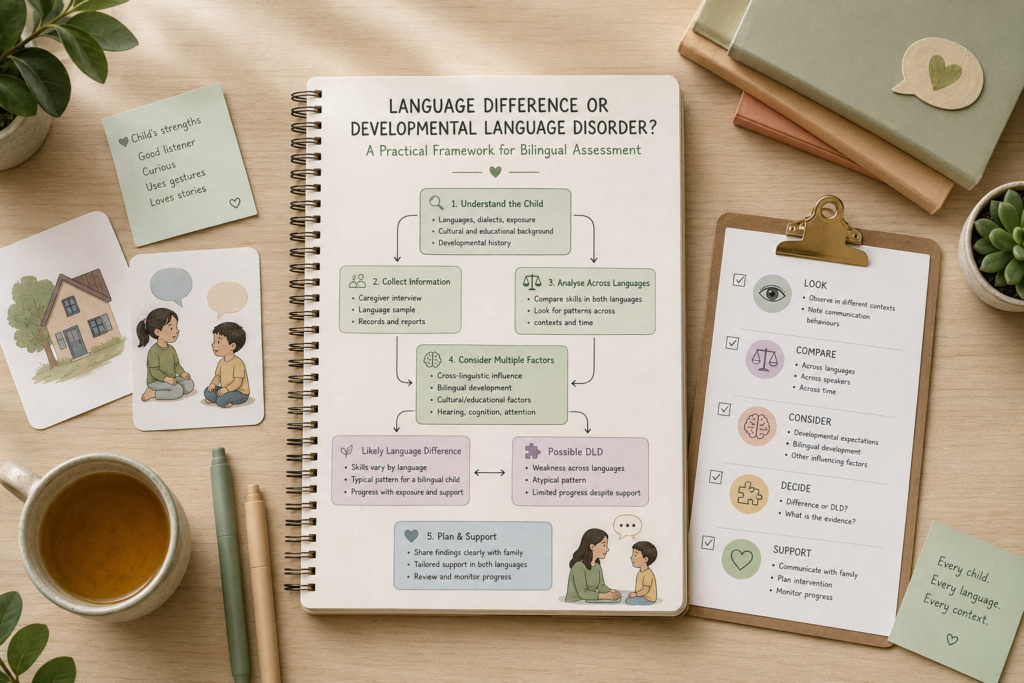
The short answer: a bilingual child should not be diagnosed with DLD on the basis of low English scores alone. The assessment needs to establish whether the child shows persistent language-learning difficulties beyond what their language exposure would predict. That requires evidence from across their languages, a detailed language history, parent report and, where appropriate, dynamic assessment.
Key points
- Bilingualism does not cause DLD.
- Low English scores alone do not establish DLD.
- A translated English test is not automatically valid in another language.
- Assessment should draw on evidence across the child’s languages.
- Parent report and dynamic assessment are particularly useful when direct assessment is not possible.
- Diagnosis should rest on converging evidence, not one test score.
What the diagnostic criteria actually require
CATALISE is unusually direct here. Consensus statement 4 reads: “Some children may have language needs because their first or home language differs from the local language, and they have had insufficient exposure to the language used by the school or community to be fully fluent in it. This should not be regarded as language disorder, unless there is evidence that the child does not have age-appropriate skills in any language.” [1]
That is a diagnostic requirement, not a courtesy. If you have assessed only English, you have not tested the criterion. The first CATALISE paper adds that where a genuine language problem exists it will be evident in the home language, and that where direct assessment is not feasible, family report and dynamic assessment are the recommended routes rather than optional extras [2].
For an Arabic-English bilingual child who is struggling with English at school, ask what communication looks like in Arabic at home too. Age-appropriate skills in Arabic would point away from a difficulty affecting language development across languages; comparable concerns in both languages would strengthen the case for further investigation.
It is worth knowing what our prevalence figures cover. SCALES gives the familiar 7.58% for language disorder of unknown origin at school entry, roughly two children per reception class [3]. It excluded children with EAL, around 10.7% of the screened sample, because assessing 64 home languages was not feasible. We have no UK prevalence estimate for bilingual children, so treat any figure you are offered with suspicion.
The misconceptions still doing damage
Bilingualism does not cause a language disorder, does not worsen one, and is not a reason to withhold a diagnosis. The RCSLT position is unambiguous on all three, and adds that bilingual people are vulnerable to misdiagnosis where diversity is mistaken for disorder [4].
Code-switching is the one I still hear described as a red flag. Spanish-English children with SLI code-switch no more often than typically developing peers, and follow the same grammatical constraints when they do [5]. In a cohort of English-Mandarin five to six year olds, more code-switching predicted better teacher-rated language six months later [6]. It tracks dominance and context, not pathology.
The silent period deserves more caution than it gets. The classic study of children in this phase found they were not silent at all: they were engaged in extensive private speech, rehearsing and recombining what they had heard [7]. Work with Early Years educators found shyness prolonged the phase, and that children did better keeping their home language going alongside non-verbal communication rather than being left quiet [8]. Reduced output is common and not alarming in itself. Using the phrase to justify a year of watchful waiting is a different thing, particularly where a child is quiet in both languages, which is not what the concept describes.
Then there is the advice to switch to English at home. A UK study of Polish-English children found Polish exposure predicted Polish outcomes, with correlations to English outcomes near zero or positive [9]. Home language maintenance alongside majority language proficiency is associated with better child wellbeing and stronger parent-child relationships, though the direction of that relationship is unestablished [10]. The parallel autism literature shows no evidence of harm from bilingual exposure, yet most parents in one review had been advised against it anyway [11].
Getting the language history right
This is the highest-yield part of the assessment and the one most often reduced to a tick box. Alongside the case history you want a separate language exposure and usage form: age of first exposure to each language, current input and output by person and setting, and the parents’ own views on bilingualism, rather than a label like “Polish at home”.
Three findings make that history interpretable. Amount of exposure matters more than timing of onset: children with roughly equal exposure to two languages matched monolinguals on receptive vocabulary whether exposure began before six months or after twenty [12], and at 30 months, toddlers with 60% or more exposure to English performed like monolingual peers [13]. Convergence also takes longer than services assume. English language learners need more than three years to approach monolingual norms, and get there asynchronously across subdomains [14]; in a longitudinal Chinese-English cohort, most reached monolingual levels on most tests by around 5.5 years of exposure [15].
Asynchrony is the clinically useful part. In a UK sample of Turkish-English children with two to nearly seven years of English, tense morphology and grammatical comprehension held up far better than vocabulary and complex syntax, and environmental factors contributed nothing to tense morphology while explaining much of the vocabulary variance [16]. That is why vocabulary is a poor basis for a diagnostic decision. Some grammatical markers may be less sensitive to differences in exposure than vocabulary, although this depends on the languages involved.
Why translated tests do not solve this
Translating a standardised test preserves linguistic equivalence at best. Functional, cultural and metric equivalence have to hold too, and usually do not: the task may not measure the same construct, items may assume unfamiliar experience, and difficulty ordering and norms do not transfer [17]. A translated test with monolingual norms is not a bilingual assessment.
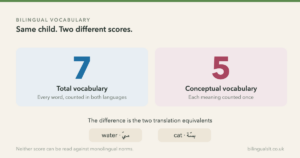
Conceptual scoring is a real improvement and worth doing: it closed the monolingual-bilingual gap for receptive vocabulary in one study and narrowed it expressively [18]. But in a sample of 247 Spanish-English children, no scoring method, monolingual or conceptual, reached the minimum standard of 80% sensitivity and specificity [19]. It makes a score fairer. It does not make a vocabulary test diagnostic.
Measures with cross-linguistic evidence behind them
Quasi-universal nonword repetition is built from phoneme inventories and syllable structures common across languages. In the clearest demonstration of why that matters, a language-specific Dutch task dropped from 93% to 63% sensitivity with bilingual children, while the quasi-universal version held at 83% sensitivity and 93% specificity in both groups [20]. A meta-analysis of 35 studies found its discrimination approaches rather than comfortably exceeds acceptable thresholds, and recommends pairing it with other measures [21].
Sentence repetition has the strongest single-marker evidence. A meta-analysis of 46 studies across 19 languages found typically developing children outperformed children with DLD by an average of 2.08 standard deviations [22]. In Russian-Hebrew bilinguals, monolingual cut-offs produced inadequate accuracy, while bilingual cut-offs gave 100% sensitivity and 89% specificity for the societal language task alone [23]. The cut-off, not the task, is usually what fails us. The LITMUS authors advise against administering it where second language exposure is under twelve months, or without a detailed language history [24].
MAIN gives you a standardised narrative procedure across more than 100 languages, free after registration, though the protocol states it has not been normed. Macrostructure showed effects of impairment but no effect of bilingualism in one Dutch cohort [25], while an English-Hebrew study found macrostructure did not differentiate and microstructure did [26]. Insensitivity to bilingualism and sensitivity to DLD are not the same property, and macrostructure has better evidence for the first.
Parent report earns its place when direct home language assessment is not possible. The ALDeQ covers early milestones, current first language ability, behaviour and family history [27], and the PaBiQ adds structured exposure indices [28]. A questionnaire drawing on both achieved 85% sensitivity and 84% specificity in bilingual children referred to clinics [29]. Screening rather than diagnosis, but a defensible way of addressing the “any language” requirement.
Arabic–English bilingual children
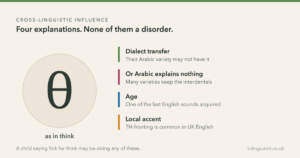
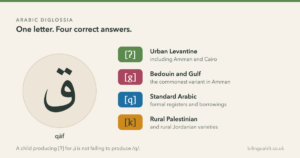
Everything above applies to Arabic–English children, but Arabic adds an important consideration that English-only assessment can miss: the variety of Arabic a child hears and uses. Many children use a spoken dialect at home, while Modern Standard Arabic (MSA) is mainly the variety of reading, writing and more formal settings, and how much of it a child has encountered varies [35]. The variety a task is written in therefore matters as well as the language.
In Palestinian Arabic-speaking children in northern Israel, words and nonwords containing MSA sounds that do not occur in the children’s dialect were repeated less accurately by all children, and the effect was larger in children with language impairment [35]. An error on an unfamiliar MSA form is therefore weak evidence of disorder on its own. Assessment needs to take the child’s spoken dialect into account. In the Palestinian Arabic sentence-repetition study described below, dialect-appropriate responses were accepted rather than marked as errors [36].
Tests normed on one dialect are a further consideration. The Arabic tools with published development work are dialect-specific: ALEF was developed with 467 Gulf Arabic-speaking children in Saudi Arabia, and its authors describe further norming as still needed [37]. A German study of Syrian refugee and heritage-speaking children had to adapt the Lebanese-normed ELO-L into a Syrian Arabic version, and norm-referencing was not applicable for part of its sample [38]. A score based on norms from a different Arabic-speaking population therefore needs careful interpretation; sharing the label “Arabic” does not make the child’s dialect, exposure or linguistic experience equivalent to the norming sample.
The same study found that typically developing children who had grown up with Arabic alongside German scored lower on the Arabic standardised test than refugee children who had used only Arabic until they left Syria, particularly on vocabulary [38]. Although this was an Arabic–German rather than Arabic–English sample, it illustrates why reduced performance in a heritage language can reflect language experience as well as disorder. For an Arabic–English child, a low Arabic score should therefore be interpreted alongside exposure, use and performance across the child’s languages rather than treated as diagnostic on its own.
Arabic-specific research also suggests that sentence repetition may be clinically useful. A LITMUS task developed in Palestinian Arabic separated 30 children with DLD from 60 typically developing peers with 93% sensitivity and 93–98% specificity, depending on the scoring method. Children with DLD had difficulty both with Arabic-specific morphology, such as tense and agreement, noun plurals and possessive suffixes, and with complex sentences with non-canonical word order [36]. The authors caution that comparing children at opposite ends of the ability range may have inflated those figures, and recommend using the task alongside other measures [36].
Importantly, these studies do not establish diagnostic accuracy for Arabic–English bilingual children. The evidence base for Arabic–English bilingual children remains limited, and appropriate norms are not available for many combinations of dialect and bilingual experience. Until we have it, the framework above holds: take a language history that records which dialect the child hears and from whom, and gather Arabic evidence through structured parent report or a dialect-matched task where one exists. Where available norms do not represent the child’s dialect or language experience, report that limitation explicitly and place greater weight on converging evidence across language history, parent report, language sampling, appropriately adapted tasks and dynamic assessment.
Dynamic assessment
Dynamic assessment is the most defensible option where no normative data exists, and the most demanding of clinician skill. The consistent cross-study finding is that clinician ratings of modifiability, how readily a child takes up teaching, discriminate between groups, while raw gain scores largely do not [30]. Reported accuracy is good: around 89% sensitivity and specificity for narrative dynamic assessment with English language learners [31], and the UK DAPPLE work found referred bilingual children needed more prompting and retained fewer taught items than matched controls [32].
Two caveats belong in the same breath. Both systematic reviews rate the included studies as methodologically poor, with small samples and few language pairs [30], [33]. And it is not free: DAPPLE runs under an hour [32], while the narrative protocol took about an hour and ten minutes to administer plus another hour of transcription and coding [31].
A sequence you can actually run
- Take the language history first, in enough detail to estimate exposure by language and setting. Interpret English repetition tasks particularly cautiously where exposure has been brief. The LITMUS authors advise against administering their sentence-repetition task when second-language exposure is under twelve months [24].
- Check for differentiating conditions. CATALISE distinguishes DLD from language disorder associated with a known biomedical condition, including sensorineural hearing loss [1]. Hearing status therefore forms part of the wider clinical picture when interpreting a child’s language difficulties.
- Establish whether there is concern in the home language, through structured parent report where direct assessment is not possible.
- Check whether descriptive or normative data exists for that language before assuming it does not.
- Use measures that travel: quasi-universal nonword repetition, sentence repetition with bilingual cut-offs where they exist, narrative sampling.
- Where no norms exist, use dynamic assessment and rate modifiability, not gain.
- Interpret converging evidence rather than a single score, and record which parts of the “any language” criterion you could and could not test.
Where this leaves us
A meta-analysis of bilingual language assessment found that from 771 citations, only measures from 17 studies were analysable, covering roughly 100 children with language impairment, and confidence intervals for every measure included uninformative values [34]. Diagnostic accuracy evidence is still dominated by Spanish-English work in the US and a handful of European pairs. Descriptive data is a different picture, and more widely available than most of us assume. It can often add information that standardised assessment cannot, particularly when appropriate norm-referenced tools are unavailable.
None of that is a reason to fall back on an English standardised score. It is a reason to be explicit about what you tested, in which languages, and what uncertainty remains. A report saying “assessed in English only; home language reported as age-appropriate by both parents; criteria for DLD not met on current evidence” is more useful than one giving a standard score of 68 without comment. This framework will not make the decisions easy. It should make them defensible.
References
- Bishop, D.V.M., Snowling, M.J., Thompson, P.A., Greenhalgh, T., & the CATALISE-2 consortium (2017). Phase 2 of CATALISE: a multinational and multidisciplinary Delphi consensus study of problems with language development: Terminology. Journal of Child Psychology and Psychiatry, 58(10), 1068-1080. https://doi.org/10.1111/jcpp.12721
- Bishop, D.V.M., Snowling, M.J., Thompson, P.A., Greenhalgh, T., & the CATALISE consortium (2016). CATALISE: A multinational and multidisciplinary Delphi consensus study. Identifying language impairments in children. PLOS ONE, 11(7), e0158753. https://doi.org/10.1371/journal.pone.0158753
- Norbury, C.F., Gooch, D., Wray, C., Baird, G., Charman, T., Simonoff, E., Vamvakas, G., & Pickles, A. (2016). The impact of nonverbal ability on prevalence and clinical presentation of language disorder: evidence from a population study. Journal of Child Psychology and Psychiatry, 57(11), 1247-1257. https://doi.org/10.1111/jcpp.12573
- Royal College of Speech and Language Therapists. Bilingualism: clinical information. https://www.rcslt.org/speech-and-language-therapy/clinical-information/bilingualism/
- Gutiérrez-Clellen, V.F., Simón-Cereijido, G., & Leone, A.E. (2009). Code-switching in bilingual children with specific language impairment. International Journal of Bilingualism, 13(1), 91-109. https://doi.org/10.1177/1367006909103530
- Yow, W.Q., Tan, J.S.H., & Flynn, S. (2018). Code-switching as a marker of linguistic competence in bilingual children. Bilingualism: Language and Cognition, 21(5), 1075-1090. https://doi.org/10.1017/S1366728917000335
- Saville-Troike, M. (1988). Private speech: evidence for second language learning strategies during the ‘silent’ period. Journal of Child Language, 15(3), 567-590. https://doi.org/10.1017/S0305000900012575
- Harris, R. (2019). Re-assessing the place of the “silent period” in the development of English as an Additional Language among children in Early Years settings. TEANGA: The Journal of the Irish Association for Applied Linguistics, 10, 77-93. https://doi.org/10.35903/teanga.v10i0.71
- Grose-Hodge, M., Dąbrowska, E., & Divjak, D. (2025). Bilingual acquisition during school years: predictors of achievement in the societal and heritage language. Frontiers in Language Sciences, 3, 1419563. https://doi.org/10.3389/flang.2024.1419563
- Müller, L.-M., Howard, K., Wilson, E., Gibson, J., & Katsos, N. (2020). Bilingualism in the family and child well-being: a scoping review. International Journal of Bilingualism, 24(5-6), 1049-1070. https://doi.org/10.1177/1367006920920939
- Drysdale, H., van der Meer, L., & Kagohara, D. (2015). Children with autism spectrum disorder from bilingual families: a systematic review. Review Journal of Autism and Developmental Disorders, 2(1), 26-38. https://doi.org/10.1007/s40489-014-0032-7
- Thordardottir, E. (2011). The relationship between bilingual exposure and vocabulary development. International Journal of Bilingualism, 15(4), 426-445. https://doi.org/10.1177/1367006911403202
- Cattani, A., Abbot-Smith, K., Farag, R., Krott, A., Arreckx, F., Dennis, I., & Floccia, C. (2014). How much exposure to English is necessary for a bilingual toddler to perform like a monolingual peer in language tests? International Journal of Language & Communication Disorders, 49(6), 649-671. https://doi.org/10.1111/1460-6984.12082
- Paradis, J. (2016). The development of English as a second language with and without specific language impairment: clinical implications. Journal of Speech, Language, and Hearing Research, 59(1), 171-182. https://doi.org/10.1044/2015_JSLHR-L-15-0008
- Paradis, J., & Jia, R. (2017). Bilingual children’s long-term outcomes in English as a second language: language environment factors shape individual differences in catching up with monolinguals. Developmental Science, 20(1), e12433. https://doi.org/10.1111/desc.12433
- Chondrogianni, V., & Marinis, T. (2011). Differential effects of internal and external factors on the development of vocabulary, tense morphology and morpho-syntax in successive bilingual children. Linguistic Approaches to Bilingualism, 1(3), 318-345. https://doi.org/10.1075/lab.1.3.05cho
- Peña, E.D. (2007). Lost in translation: methodological considerations in cross-cultural research. Child Development, 78(4), 1255-1264. https://doi.org/10.1111/j.1467-8624.2007.01064.x
- Gross, M., Buac, M., & Kaushanskaya, M. (2014). Conceptual scoring of receptive and expressive vocabulary measures in simultaneous and sequential bilingual children. American Journal of Speech-Language Pathology, 23(4), 574-586. https://doi.org/10.1044/2014_AJSLP-13-0026
- Anaya, J.B., Peña, E.D., & Bedore, L.M. (2018). Conceptual scoring and classification accuracy of vocabulary testing in bilingual children. Language, Speech, and Hearing Services in Schools, 49(1), 85-97. https://doi.org/10.1044/2017_LSHSS-16-0081
- Boerma, T., Chiat, S., Leseman, P., Timmermeister, M., Wijnen, F., & Blom, E. (2015). A quasi-universal nonword repetition task as a diagnostic tool for bilingual children learning Dutch as a second language. Journal of Speech, Language, and Hearing Research, 58(6), 1747-1760. https://doi.org/10.1044/2015_JSLHR-L-15-0058
- Schwob, S., Eddé, L., Jacquin, L., Leboulanger, M., Picard, M., Ramos Oliveira, P., & Skoruppa, K. (2021). Using nonword repetition to identify developmental language disorder in monolingual and bilingual children: a systematic review and meta-analysis. Journal of Speech, Language, and Hearing Research, 64(9), 3578–3593. https://doi.org/10.1044/2021_JSLHR-20-00552
- Ward, L., Polišenská, K., & Bannard, C. (2024). Sentence repetition as a diagnostic tool for developmental language disorder: a systematic review and meta-analysis. Journal of Speech, Language, and Hearing Research, 67(7), 2191-2221. https://doi.org/10.1044/2024_JSLHR-23-00490
- Armon-Lotem, S., & Meir, N. (2016). Diagnostic accuracy of repetition tasks for the identification of specific language impairment (SLI) in bilingual children: evidence from Russian and Hebrew. International Journal of Language & Communication Disorders, 51(6), 715-731. https://doi.org/10.1111/1460-6984.12242
- Marinis, T., & Armon-Lotem, S. (2015). Sentence repetition. In S. Armon-Lotem, J. de Jong & N. Meir (Eds.), Assessing Multilingual Children: Disentangling Bilingualism from Language Impairment (pp. 95–122). Bristol: Multilingual Matters.
- Boerma, T., Leseman, P., Timmermeister, M., Wijnen, F., & Blom, E. (2016). Narrative abilities of monolingual and bilingual children with and without language impairment: implications for clinical practice. International Journal of Language & Communication Disorders, 51(6), 626-638. https://doi.org/10.1111/1460-6984.12234
- Altman, C., Armon-Lotem, S., Fichman, S., & Walters, J. (2016). Macrostructure, microstructure, and mental state terms in the narratives of English-Hebrew bilingual preschool children with and without specific language impairment. Applied Psycholinguistics, 37(1), 165-193. https://doi.org/10.1017/S0142716415000466
- Paradis, J., Emmerzael, K., & Sorenson Duncan, T. (2010). Assessment of English language learners: using parent report on first language development. Journal of Communication Disorders, 43(6), 474-497. https://doi.org/10.1016/j.jcomdis.2010.01.002
- Tuller, L. (2015). Clinical use of parental questionnaires in multilingual contexts. In S. Armon-Lotem, J. de Jong & N. Meir (Eds.), Assessing Multilingual Children: Disentangling Bilingualism from Language Impairment (pp. 301-330). Bristol: Multilingual Matters.
- Abutbul-Oz, H., & Armon-Lotem, S. (2022). Parent questionnaires in screening for developmental language disorder among bilingual children in speech and language clinics. Frontiers in Education, 7, 846111. https://doi.org/10.3389/feduc.2022.846111
- Orellana, C.I., Wada, R., & Gillam, R.B. (2019). The use of dynamic assessment for the diagnosis of language disorders in bilingual children: a meta-analysis. American Journal of Speech-Language Pathology, 28(3), 1298-1317. https://doi.org/10.1044/2019_AJSLP-18-0202
- Peña, E.D., Gillam, R.B., & Bedore, L.M. (2014). Dynamic assessment of narrative ability in English accurately identifies language impairment in English language learners. Journal of Speech, Language, and Hearing Research, 57(6), 2208-2220. https://doi.org/10.1044/2014_JSLHR-L-13-0151
- Hasson, N., Camilleri, B., Jones, C., Smith, J., & Dodd, B. (2013). Discriminating disorder from difference using dynamic assessment with bilingual children. Child Language Teaching and Therapy, 29(1), 57-75. https://doi.org/10.1177/0265659012459526
- Hunt, E., Nang, C., Meldrum, S., & Armstrong, E. (2022). Can dynamic assessment identify language disorder in multilingual children? Clinical applications from a systematic review. Language, Speech, and Hearing Services in Schools, 53(2), 598-625. https://doi.org/10.1044/2021_LSHSS-21-00094
- Dollaghan, C.A., & Horner, E.A. (2011). Bilingual language assessment: a meta-analysis of diagnostic accuracy. Journal of Speech, Language, and Hearing Research, 54(4), 1077-1088. https://doi.org/10.1044/1092-4388(2010/10-0093)
- Saiegh-Haddad, E., & Ghawi-Dakwar, O. (2017). Impact of diglossia on word and non-word repetition among language impaired and typically developing Arabic native speaking children. Frontiers in Psychology, 8, 2010. https://doi.org/10.3389/fpsyg.2017.02010
- Taha, J., Stojanovik, V., & Pagnamenta, E. (2021). Sentence repetition as a clinical marker of developmental language disorder: evidence from Arabic. Journal of Speech, Language, and Hearing Research, 64(12), 4876-4899. https://doi.org/10.1044/2021_JSLHR-21-00244
- Rakhlin, N.V., Aljughaiman, A., & Grigorenko, E.L. (2021). Assessing language development in Arabic: the Arabic Language: Evaluation of Function (ALEF). Applied Neuropsychology: Child, 10(1), 37-52. https://doi.org/10.1080/21622965.2019.1596113
- Hamann, C., Chilla, S., Abed Ibrahim, L., & Fekete, I. (2020). Language assessment tools for Arabic-speaking heritage and refugee children in Germany. Applied Psycholinguistics, 41(6), 1375-1414. https://doi.org/10.1017/S0142716420000399
About the author
Bodour Imseeh is a Speech and Language Therapist specialising in bilingualism, phonology, speech sound disorders and early literacy. She works across school-based and private caseloads and is fluent in Arabic and English. Read more on the About page.