Good Arabic–English bilingual resources can be hard to find, so I’ve pulled together a list of genuinely free tools and references for assessment, intervention and supporting families.
Search for “free bilingual speech therapy resources” and you’ll get plenty back. Search for anything built specifically around an Arabic-English caseload, and the results thin out fast, mostly generic Spanish-English materials with “bilingual” in the title, or academic papers behind a paywall. If you’re an SLT or SLP working with Arabic-speaking families, or a parent trying to understand what typical bilingual development looks like, here’s a genuinely useful, actually free starting list.
What resources help clinicians?
ASHA’s Practice Portal on Multilingual Service Delivery[1] is the single best free reference for assessment and intervention principles across languages, dynamic assessment, working with interpreters, case history frameworks, all free to browse without a membership.
RCSLT’s clinical information on bilingualism[2] is the UK equivalent, aimed specifically at speech and language therapists navigating bilingual caseloads within NHS and independent practice contexts.
For Arabic specifically, the Multilingual Children’s Speech website at Charles Sturt University keeps a free table of speech acquisition studies[3] organised by language and dialect, including Egyptian, Jordanian, Kuwaiti and Lebanese Arabic studies such as Amayreh and Dyson’s Jordanian norms. Many of the papers themselves sit behind journal paywalls, so we’ve summarised the Jordanian findings in our Arabic speech sound milestones guide.
The same site offers the Intelligibility in Context Scale[4] free in Arabic and in a bilingual Arabic–English version. It is a quick parent-rated measure of how well a child is understood by different listeners. It hasn’t been validated in Arabic, so treat it as structured parent report rather than a normed test.
For vocabulary, the Arabic CDI[5] from the University of Plymouth is a free 100-word parent checklist for children aged about 8 to 30 months. It is available in separate versions for 17 Arabic dialects, each of which can be downloaded, and it can also be completed and scored online. Its norms come from Egyptian children and are only tentatively applied to other Arabic-speaking countries. For an Arabic–English child, interpret it alongside information about the child’s English vocabulary and overall language exposure.
Newcastle University’s Bulbul project[6], which studies Arabic-speaking children’s language development, maintains a resource hub for practitioners and families, including parent tip sheets in Arabic.
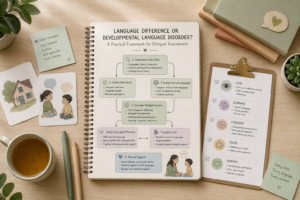
For the “difference or disorder” question itself, our practical framework for bilingual assessment sets out what the evidence supports, including a section on assessing Arabic–English children.
What resources help families?
Bilingualism Matters[7], a research and public information centre founded at the University of Edinburgh with partner branches internationally, publishes free leaflets, FAQs, and a podcast aimed squarely at parents and teachers navigating bilingual development, no academic background required.
If you’d like something in Arabic, the National Literacy Trust’s short tip sheet on talking to your child in your own language[8] is available as a free Arabic download.
Our own parent guides are also available in Arabic:
- لماذا يصعب فهم كلام طفلي؟ وضوح الكلام عند الأطفال ثنائيي اللغة
- طفلي يمزج بين العربية والإنجليزية. هل هذا طبيعي؟
- الروتينات اليومية التي تبني اللغتين لدى طفلك
- طفلي ثنائي اللغة يخضع للتقييم. ماذا أتوقع؟
- طفلي ثنائي اللغة لا يتكلّم بعد. متى يجب أن أقلق؟
- هل التحدّث بلغتين هو سبب تأخّر الكلام عند طفلي؟
And from us
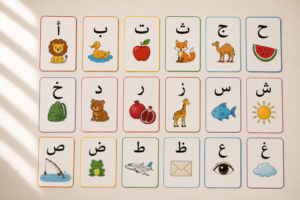
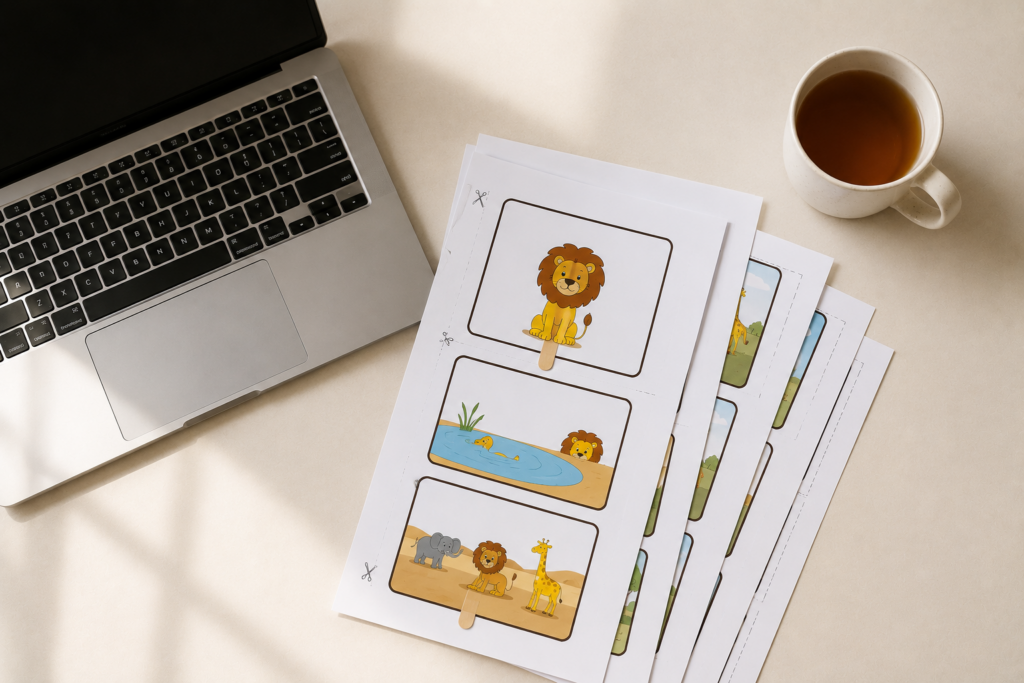
We’re building out our own library of free resources for Arabic-English caseloads specifically, the gap this whole list is really pointing at. First up is our free Lion positional concepts pack, a ready-to-use activity for practising basic positional vocabulary in both languages.
Get the free Lion positional concepts pack
For Arabic phonology, our free Arabic speech sound milestones guide summarises when Arabic consonants develop, based on Jordanian research. Clinicians looking for a structured assessment resource can also find our Arabic Phonology Screen in the shop (£14.99).
The bottom line
Good free resources for Arabic-English bilingual caseloads exist, they’re just scattered across professional bodies, university research projects and charities rather than gathered in one place. Start with the list above, and keep an eye on ours as we build out resources built specifically for this caseload rather than adapted from somewhere else.
Links last checked: 28 September 2026.
Where to go next
- Arabic Speech Sounds for English-Speaking Clinicians — Free side-view animations and production notes for Arabic sounds that have no close English equivalent. The page and production notes are free to read, and the ص animation is open to everyone; the ط, خ and ق animations need a free account.
- Speech Sound Disorders: Learn, Differentiate, Treat — Pages on identifying and treating speech sound disorders, with interactive comparison and approach tools. The pages are free to read; most Differential Tool comparisons, the Approach Finder with your own findings and the two printables need a free account.
References
- American Speech-Language-Hearing Association. Multilingual service delivery in audiology and speech-language pathology (Practice Portal). https://www.asha.org/practice-portal/professional-issues/multilingual-service-delivery/
- Royal College of Speech and Language Therapists. Bilingualism. https://www.rcslt.org/speech-and-language-therapy/clinical-information/bilingualism/
- Charles Sturt University. Multilingual Children’s Speech: Speech acquisition studies. https://www.csu.edu.au/research/multilingual-speech/speech-acquisition/speech-acq-studies
- Charles Sturt University. Multilingual Children’s Speech: Intelligibility in Context Scale (ICS). https://www.csu.edu.au/research/multilingual-speech/speech-assessments/ics
- University of Plymouth. The Arabic CDI – Words Only. https://www.psy.plymouth.ac.uk/OpenArabicCDI/
- Newcastle University. Bulbul: Resources. https://research.ncl.ac.uk/bulbul/forpractitioners/resources/
- Bilingualism Matters. Bilingualism Matters. https://www.bilingualism-matters.org/
- National Literacy Trust. Talk to your baby and child in your own language (Arabic). https://cdn.literacytrust.org.uk/media/documents/2017_07_05_free_ELY_resource_-_talkinghomelangarabic.pdf