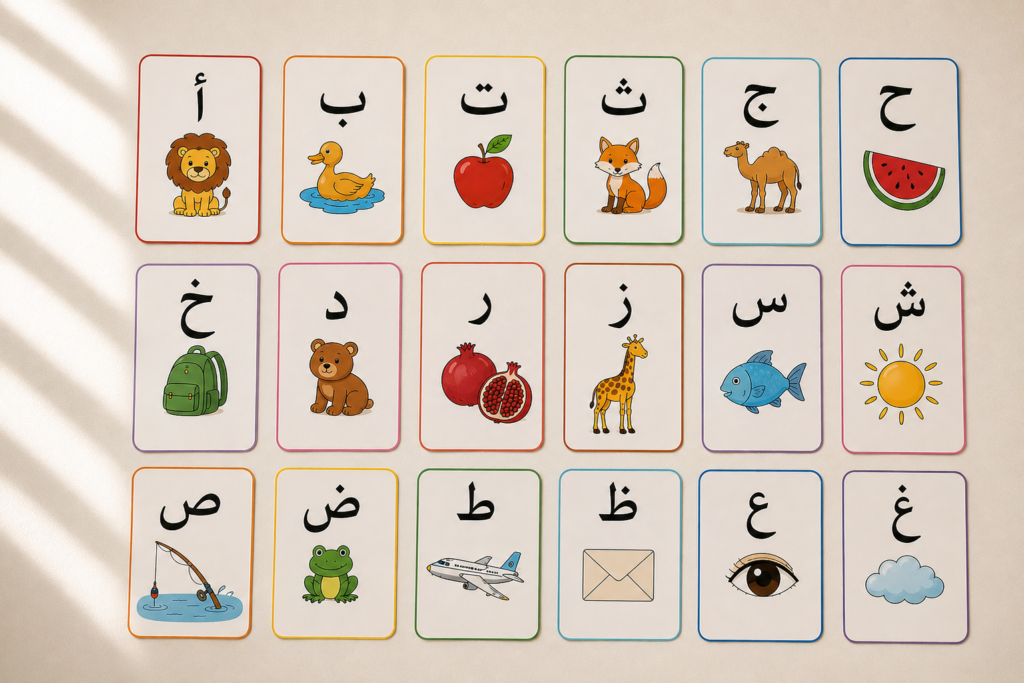
Arabic-speaking children acquire many consonants at broadly similar ages to English-speaking children, but with notable exceptions, and Arabic has consonants that English doesn’t have at all. Knowing what’s typical for each age—and each Arabic dialect—is essential for accurate assessment.
If you’ve gone looking for straightforward, non-academic information on when Arabic-speaking children should be producing which sounds, you’ve probably come up close to empty-handed. Milestone charts online are almost all built around English. That’s a real problem, because Arabic has its own sound system, including several consonants that don’t exist in English at all, so an English timeline can’t simply be applied to an Arabic-speaking child’s speech.
Here’s what the actual research on Arabic phonological development says, organised by roughly when each group of sounds tends to appear.
Quick answer
In Jordanian normative data, consonants such as /b/, /t/, /d/, /k/, /f/, /m/ and /n/ were acquired (produced correctly by at least 75% of children in every word position) before age 4, and /s/ at around 5, while /z/, /θ/ and /ð/ were not yet acquired in their standard form by 6;4.[1] Emphatic consonants come later than their plain counterparts; in a study of Ammani Arabic-speaking children, accuracy on /tˤ/, /dˤ/ and /sˤ/ reached at least 75% at age 4 and at least 90% at age 5.[4] Treat these as reference ages rather than cut-offs, because dialect and register shape the details.[2][5]
Arabic consonants at a glance (one Jordanian study)
| Stage (age at which the sound was acquired) | Examples of sounds | Source |
|---|---|---|
| Earlier: before age 4 | /b/, /t/, /d/, /k/, /f/, /m/, /n/ and ح /ħ/ | Amayreh & Dyson (1998) [1] |
| Intermediate: between 4;0 and 6;4 | /s/, خ /χ/, غ /ʁ/ | Amayreh & Dyson (1998) [1] |
| Later: not yet acquired in the standard form by 6;4 | /z/, /θ/, /ð/, ع /ʕ/, ق /q/ and the emphatic consonants | Amayreh & Dyson (1998) [1] |
Based on Amayreh and Dyson’s study of 180 Jordanian children aged 2;0–6;4, where a sound counts as acquired once at least 75% of children in an age group produced it correctly in every word position tested.[1] Everyday dialect forms of some sounds, such as ق, were acquired earlier than the standard form, and a child’s dialect can shift when particular forms appear. Newer, smaller studies of children in Amman found some sounds earlier or later; see the sections on emphatic consonants and on pharyngeal and uvular sounds.
Why does Arabic need its own milestones chart?
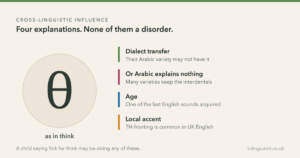
English speech milestone charts are built around English’s own sound inventory, no pharyngealized consonants, no pharyngeal fricatives, no uvular stop. Arabic has all three, alongside sounds that look similar to English on paper, θ as in “think”, ð as in “this”. Both are late-developing sounds in English too, but in the Jordanian data neither was acquired in its standard form by 6;4, and ð was acquired later than in English studies. None of that is captured by translating an English chart. The best available evidence instead comes from dedicated normative studies of Arabic-speaking children themselves, most substantially from a large study of 180 Jordanian Arabic-speaking children between the ages of 2;0 and 6;4.[1]
When do early Arabic sounds develop? (Before age 4)
Stops, nasals, and a handful of fricatives are typically the first sounds to fall into place. In the Jordanian normative data, /b/, /t/, /d/, /k/, /f/, /m/ and /n/ were already produced correctly by at least half of the children in the youngest group studied (2;0–2;4), and all of them were acquired, meaning at least 75% of children produced them correctly in every word position, by 3;4.[1] Full mastery (at least 90% of children) took longer for some: /f/, /k/, /m/ and /n/ by 3;6, /t/ by 4;0, /b/ by 4;6 and /d/ not until 6;0.[1] By this stage, a child’s Arabic consonant system already covers a good working range for everyday speech.
When do mid-range sounds develop? (Around age 4 to 6)
The sibilant /s/ takes noticeably longer. In the Jordanian data it was produced correctly by at least half of children from 3;0 and acquired (75%) at 5;0–5;4, but had not reached full mastery (90%) even in the oldest group, 6;0–6;4.[1] A more recent study of Ammani Arabic-speaking children found plain /s/ mastered by 5;0–5;11.[4] So a 3-year-old who hasn’t got /s/ yet is well within the range represented in these data, while the exact age at which /s/ reaches mastery differs between the available Jordanian studies.
When do late sounds appear: /z/, /θ/, and /ð/?
/z/, along with the interdental sounds /θ/ and /ð/, were among the latest sounds in the original study, still not acquired in their standard form even by the oldest children tested at 6;4.[1] A follow-up study tracked these late sounds further, in children aged 6;6 to 8;4, and found a genuinely useful nuance: in their strict, formal Educated Spoken Arabic form, /θ/ and /ð/ still weren’t acquired even by the oldest children in the study (/z/ was, by 6;6–7;4), but in the everyday, acceptable colloquial forms children actually use in daily speech, most of these late sounds were acquired by 7;4 and all of them by 8;4.[2] In practice, that gap between “textbook-correct” and “everyday-correct” matters, a child isn’t behind for not yet nailing a formal register form they’ll rarely need before school age.
When do emphatic consonants develop?
The emphatic, or pharyngealized, consonants (/tˤ/, /dˤ/, /sˤ/, /ðˤ/) are one of Arabic’s genuinely distinctive features, sounds with no equivalent in English, produced with the tongue root pulled back toward the pharynx. Complex sounds like these tend to be late developers cross-linguistically, and Arabic’s emphatics were traditionally described the same way.[1][3] More recent research on 60 Ammani Arabic-speaking children aged 2 to 7;11 has pushed that timeline earlier than the older studies suggested. For the three emphatics it tested, /tˤ/, /dˤ/ and /sˤ/, accuracy reached about half or more at age 3, at least 75% at age 4 and at least 90% at age 5, although fully adult-like acoustic quality came later: at 6 at the start and in the middle of words, and at 7 at the end.[4] Worth knowing if you’re used to older, more conservative norms.
When do pharyngeal and uvular sounds develop?
Arabic also includes consonants made further back in the vocal tract than most English consonants, including the pharyngeals ح /ħ/ and ع /ʕ/ and the uvulars خ /χ/ and غ /ʁ/. These sounds do not all develop at the same time.
In Amayreh and Dyson’s Jordanian study, ح was among the earlier-acquired sounds, while خ and غ fell into an intermediate stage and ع was among the later sounds.[1] A more recent study of 40 Ammani-Jordanian preschoolers found ح was acquired at 3;6–4;0, while خ and ع reached the study’s acquisition criterion at 4;6–5;0; غ had not yet reached that criterion by age 6.[7] The two studies therefore give a similar overall message—that some of these sounds develop later—but they do not give identical ages.
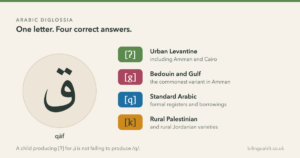
ق /q/ also needs a dialect caveat. Its standard form was late in the earlier Jordanian study, while everyday spoken variants were acquired much earlier.[1] The newer Ammani study focused on six guttural consonants and did not include /q/; it notes that /q/ tends to merge into [ʔ] in Ammani speech.[7] This is one reason a child’s Arabic dialect matters when interpreting their speech.
These findings also show why a single error on ع or غ should not be interpreted in isolation; the child’s age, dialect and wider speech system all matter.
What else shapes Arabic sound development? Word position and dialect
Two patterns cut across every sound group. First, position in the word matters more than people often expect: overall, consonants in the middle of a word were produced significantly more accurately than at the start or end of a word, with no difference between the start and the end.[1] Second, dialect matters a great deal. Children’s errors track their own home dialect more closely than formal Modern Standard Arabic, and sounds that are frequent and functionally used in a child’s own dialect tend to be acquired earlier than the equivalent MSA form.[5] Most of the normative data above comes from Jordanian and Levantine populations specifically. A separate, large study of Egyptian Arabic-speaking children exists and is a valuable addition,[6] but Gulf-specific normative data remains comparatively sparse, so treat the ages above as a strong general reference point, not a precise regional standard for every dialect a child might be speaking at home.
How do you use this in clinical practice?
None of this is usable if the tool in front of you was built for English and simply translated. A phonology screen needs to test the sounds that are actually distinctive to Arabic, in a way that accounts for the child’s own dialect and register, not just swap English words for Arabic ones on the same old form.
That’s exactly the gap our Arabic Phonology Screen was built to close.
For the nine sounds English phonetics training doesn’t cover, the Arabic Speech Sounds clinical reference works through each one, with the developmental evidence and dialect notes set out chapter by chapter.
For families, our parent milestones guide explains Arabic speech sound development in accessible language for ages 2–3, 3–4 and 4–5 years.
The bottom line
Arabic-speaking children broadly follow the same developmental logic as children learning any language, easy sounds first, complex ones later, and many consonants are acquired at similar ages to English. But several sounds follow their own timeline, and Arabic’s distinctive sounds need Arabic data, not a translated English chart. Stops and nasals early, /s/ and several other fricatives in the middle years, /z/, the interdentals and the emphatic consonants later, with dialect and register shaping the details throughout.
Where to go next
- Arabic Speech Sounds for English-Speaking Clinicians — Side-view animations and production notes for several of the sounds discussed here. The page and production notes are free to read, and the ص animation is open to everyone; the ط, خ and ق animations need a free account.
References
- Amayreh, M. M., & Dyson, A. T. (1998). The acquisition of Arabic consonants. Journal of Speech, Language, and Hearing Research, 41(3), 642–653. https://doi.org/10.1044/jslhr.4103.642
- Amayreh, M. M. (2003). Completion of the consonant inventory of Arabic. Journal of Speech, Language, and Hearing Research, 46(3), 517–529. https://doi.org/10.1044/1092-4388(2003/042)
- Alkhudidi, A., Holt, R., Szalay, T., Demuth, K., & Benders, T. (2025). The acquisition of plain–emphatic consonant contrasts by Arabic-speaking children: An acoustic study. Journal of Child Language. Advance online publication. https://doi.org/10.1017/S0305000925100214
- Mashaqba, B., Daoud, A., Zuraiq, W., & Huneety, A. (2022). Acquisition of emphatic consonants by Ammani Arabic-speaking children. Language Acquisition, 29(4), 441–456. https://doi.org/10.1080/10489223.2022.2049600
- Bergstrand Othman, L. (2025). Arabic diglossia: Advocating for a non-deficit model in comparative analysis of reading and language acquisition. Frontiers in Education, 10, 1518728. https://doi.org/10.3389/feduc.2025.1518728
- Elrefaie, D. A., Hegazi, M. A. EF., El-Mahallawi, M. M., & Khodeir, M. S. (2021). Descriptive analysis of the development of the Arabic speech sounds among typically developing colloquial Egyptian Arabic-speaking children. The Egyptian Journal of Otolaryngology, 37, 38. https://doi.org/10.1186/s43163-021-00094-w
- Mashaqba, B., & Hadban, F. (2024). Acquisition of gutturals by Ammani-Jordanian Arabic–speaking preschoolers. Journal of Speech, Language, and Hearing Research, 67(7), 2222–2243. https://doi.org/10.1044/2024_JSLHR-23-00085